Patrizia Ciofi Information


La Ciofi

Patrizia Unofficial fan-site,
dedicated to the soprano Patrizia Ciofi.
All are welcome!
Navigation panel at left.

The Voice

The voice of La Ciofi -- here in a selection of mp3 audio files and videos. Updated 8 Feb 2009.

LUCIE DE LAMMERMOOR (Lyon, Jan 2002)
LUCIA (in Lucia di Lammermoor, Ancona 2002)
GILDA (in Rigoletto, Covent Garden 2002)
AMENAIDE (in Tancredi, ROF Pesaro 2004)
DESDEMONA (in Rossini's Otello, Martina Franca 2000)
CERERE (in Le nozze di Teti e di Peleo, ROF Pesaro 2001)
SUSANNA (in Le nozze di Figaro, Amsterdam 2001)
ARICIA (in Traetta's Ippolito ed Aricia, Martina Franca 1999)
SOPHIE (in Der Rosenkavalier, Genova 2008)
ALAIDE (in La straniera, London 2007)
VIOLETTA (in La traviata, Torino 1999)
VIOLETTA (in La traviata, Orange 2009)
LAURETTA (in Gianni Schicchi, Paris 2004)
ASPASIA (in Mitridate, Paris 2000)
GIULIETTA (in I Capuleti ei Montecchi, Martina Franca 2005)
LUCIA (in Lucia di Lammermoor, Orange 2006)
Also: For complete live recordings not commercially released, visit the OperaShare yahoo-group or OperaShare google-group message archives (Rapidshare download links). Recommended: Mitridate with Frittoli, Asawa, Piau, Rousset; Rigoletto with Alvarez, Calleja, Benini; Lucia in Orange with Villazon, Guidarini; Tancredi with Pizzolato, Kunde, Perez; Soirees musicales, recital of Rossini songs.

For more mp3s, see also the Ciofi yahoo-group files section, PatriziaCiofi.com, and Facebook. For videos, try YouTube, and Google Video.

Performances

Performance history and future engagements, with links to reviews and photos. This is what I have found so far. There may be some gaps.

1989-96 | 1997 | 1998 | 1999
2000 | 2001 | 2002 | 2003 | 2004 | 2005 | 2006 | 2007 | 2008 | 2009
Future

Date Work (Role) Venue Notes
Nov 89Giovanni Sebastiano (Role?)Firenze Credits
Nov 90Don Giovanni (Donna Anna)Modena, &c Credits
Oct 91Don Pasquale (Norina)Pisa &c P
Jul 92Re Teodoro in Venezia (Lisetta)Montepulciano R.en
Dec 92Rigoletto (Gilda)Modena, Pisa &c P
May 93Falstaff (Nanetta)Pisa &c
Aug 93La pietra del paragone (Fulvia)Felixstowe R.en
Oct 93La traviata (Violetta)Livorno, &c Credits
Dec 93Boris Godunov (Ksenija)Parma Credits
Mar 94La sonnambula (Lisa)Trieste Credits
May 94Barbablù (Elisa)Bologna Credits
Jul 94La sonnambula (Amina)Martina Franca CD P
Nov 94Rigoletto (Gilda)Savona P
Jan 95Carmina BuranaPisa
Aug 95Médée (Dircé)Martina Franca CD
Oct 95La traviata (Violetta)Savona
Nov 95L'Elisir d'amore (Adina)Pisa &c
Jan 96La gazza ladra (Ninetta)Palermo Credits
Mar 96Cendrillon (Cendrillon)Torino Credits
Apr 96Giovanna d'Arco al rogoTrieste Credits
Jul 96L’Americano (Silvia)Martina Franca CD P
Sept 96La Boheme (Musetta)Novara &c Credits
Oct 96Lucia di Lammermoor (Lucia)Savona R.it R.en
Nov 96Le nozze di Figaro (Susanna)Nice Credits
Dec 96Rigoletto (Gilda)Trieste
1997 Work (Role) Venue Notes
Jan 97Divara (Divara)Catania Credits
Apr 97I Puritani (Elvira)Modena Credits V
May 97Parsifal (Flower maiden)Firenze Credits R.it
Jun 97La traviata (Violetta)Genova Credits Credits
Jul 97Lucie de Lammermoor (Lucie)Martina Franca CD P
Sep 97Tamerlano (Asteria)Torino Credits R.it R.en
Oct 97La traviata (Violetta)Milano O
Nov 97Concert: Bastianini MemorialSiena Credits
Dec 97Le nozze di Figaro (Susanna)Torino Credits R.it R.en P
1998 Work (Role) Venue Notes
Feb 98La Bohème (Musetta)Cagliari Credits P
Mar 98Il matrimonio segreto (Elisetta)Lausanne Credits
Apr 98Concert with fluteBologna Credits
Aug 98Il Re (Rosalina)Martina Franca CD P
Aug 98Mese Mariano (Carmela)Martina Franca CD P
Oct 98L’Elisir d’amore (Adina)Milano R.en
1999 Work (Role) Venue Notes
Jan 99Eleonora (Role?)Napoli Credits
Feb 99La Bohème (Musetta)Bologna Credits R.it
Mar 99Le Martyre de Saint-SébastienPalermo Credits
Jun 99Fedora (Role?)Roma Credits
Jun 99La traviata (Violetta)Torino CreditsCredits R V VV
Jul 99Ippolito ed Aricia (Aricia)Martina Franca CD P
Aug 99Concert: Leçons de ténèbresPesaro Credits
Sep 99Arminio (Tusnelda)Venezia Credits
Sep 99La sonnambula (Amina)Livorno Credits
Sep 99La sonnambula (Amina)Lucca Credits R.en P P
Oct 99La sonnambula (Amina)Pisa Credits
Dec 99Falstaff (Nanetta)Paris R.en P
2000 Work (Role) Venue Notes
Jan 00La Bohème (Musetta)Madrid R.es
Feb 00Lucia di Lammermoor (Lucia)Torino Credits P
Apr 00Mitridate, re di Ponto (Aspasia)Paris Credits R R P P V V
Apr 00Pergolesi's Stabat MaterTorino Credits
May 00Rigoletto (Gilda)Torino Credits
Jun 00Carmina BuranaPalermo Credits
Jul 00Otello, by Rossini (Desdemona)Martina Franca CD P P
Aug 00Robert le Diable (Isabelle)Martina Franca CD R +P P
Oct 00La Bohème (Musetta)Napoli Credits R.it P
Oct 00Arminio (Tusnelda)Padova Credits
Oct 00Concert: Slow FoodTorino Credits
Dec 00Siroe, re di Persia (Emira)Venezia Credits RR R R R P
2001 Work (Role) Venue Notes
Jan 01Rigoletto (Gilda)München Credits Credits
Feb 01Ippolito ed Aricia (Aricia)Montpellier R.en R.fr +P
Mar 01La sonnambula (Amina)Napoli Credits R.it
Apr 01L’Elisir d’amore (Adina)Milano Credits R.en P
Jun 01La traviata (Violetta)Avignon  
Jul 01Rigoletto (Gilda)Parma R.en
Jul 01Il Re (Rosalina)Baveno Credits P
Aug 01Le nozze di Teti e Peleo (Cerere)Pesaro R.fr
Aug 01Concert: Soirées MusicalesPesaro CreditsCredits
Sep 01Le nozze di Figaro (Susanna)Montreux R.en
Oct 01Le nozze di Figaro (Susanna)Paris Credits R.en R.en
Oct 01"Intermezzo musicale"Torino Credits
Nov 01Brahms Requiem, op.45Torino Credits
Nov 01Carmen II (Micaela)Torino Credits R.en P
Dec 01L'Olimpiade (Aristea)Venezia Credits R.fr RR P
2002 Work (Role) Venue Notes
Jan 02Lucie de Lammermoor (Lucie)Lyon DVD P
Jan 02Le nozze di Figaro (Susanna)Bilbao Credits
Jan 02MasterclassSiena Credits
Feb 02Lucia di Lammermoor (Lucia)Piacenza Credits
Feb 02Don Pasquale (Norina)Cagliari Credits
Mar 02Der Rosenkavalier (Sophie)Paris R.en R.en
May 02Die Entführung (Blonde)Firenze DVD P
Jun 02Concert: Mahler, MessiaenParis C1 C2
Jun 02Lucie de Lammermoor (Lucie)Paris R R.fr R.fr
Jul 02Mese Mariano (Carmela)Baveno Credits R.en
Aug 02Il turco in Italia (Fiorilla)Pesaro Credits R.it R.en P
Sep 02Le nozze di Figaro (Susanna)Paris R.fr +P
Sep 02Rigoletto (Gilda)London  See details 
Oct 02Concert: Vivaldi, HandelNew York C.pdf
Nov 02La traviata (Violetta)Zurich R.de
Nov 02Lucia di Lammermoor (Lucia)Ancona Credits R.it +P
Dec 02Rigoletto (Gilda)Genova Credits
2003 Work (Role) Venue Notes
Jan 03Falstaff (Nanetta)Paris Credits
Mar 03La traviata (Violetta)Chicago Credits R.en
Apr 03Così fan tutte (Fiordiligi)Torino Credits R.it R.it P
Jun 03Le nozze di Figaro (Susanna)Paris Credits R.en P
Jul 03RecitalMartina Franca Credits P
Aug 03?La traviata (Violetta)Busseto Credits R.en
Oct 03La Santissima TrinitaLyon Credits
Oct 03Le nozze di Figaro (Susanna)Firenze Credits R.it +P DVD
Nov 03Rigoletto (Gilda)Firenze R.it
Dec 03Benvenuto Cellini (Teresa)Paris R.en R.fr
Dec 03Gala Reopening of La FeniceVenezia Credits DVD
Dec 03Concerto di NataleVenezia Credits Credits
2004 Work (Role) Venue Notes
Jan 04Siroe, re di Persia (Emira)Paris R.fr R.fr
Jan 04Le nozze di Figaro (Susanna)Genova R.it
Feb 04La sonnambula (Amina)Avignon Credits R.fr P
Mar 04Madrigals of Love and WarParis Credits
Mar 04Madrigals of Love and WarLondon R.en
Mar 04Gianni Schicchi (Lauretta)Paris R.fr P V V
May 04Alcina (Morgana)Paris R.fr P
Jun 04Lucia di Lammermoor (Lucia)Cagliari Credits
Jul 04L’Elisir d’Amore (Adina)La Coruña Credits
Jul 04Carmina BuranaSpoleto Credits Credits Credits
Aug 04Tancredi (Amenaide)Pesaro  See details 
Sep 04Concert sur France MusiquesParis Credits Credits
Oct 04L’Incoronazione di PoppeaParis R.fr +P
Nov 04La traviata (Violetta)Venezia R.fr P DVD
Nov 04Concert: Prêtre turns 80Paris TCE R.fr
Dec 04Les contes d’Hoffman (All 4)Marseille R.fr R.fr +P R V
2005 Work (Role) Venue Notes
Jan 05La sonnambula (Amina)Bologna Credits R.it R.it +P
Feb 05La fille du régiment (Marie)Genova R R R +P DVD
Mar 05Airs d'opéras napolitainsMetz Credits
Apr 05Concert: BoccheriniBologna Credits
Apr 05Pia de' Tolomei (Pia)Venezia Credits R R CD/DVD
May 05La traviata (Violetta)Tokyo
Nagoya
Credits
Credits Credits
Jun 05Concert: BoccheriniBologna Credits
Aug 05I Capuleti ei MontecchiMartina Franca Credits R P CD/DVD
Sep 05Concert with Rolando VillazónTokyo Credits R
Oct 05Le nozze di Figaro (Susanna)Paris TCE Credits R R R P
Nov 05Il viaggio a Reims (Folleville)Monte Carlo Credits R R.fr +P P P
2006 Work (Role) Venue Notes
Jan 06Chérubin (L'Ensoleillad)Cagliari Credits R R CD/DVD
Feb 06L'Elisir d'amore (Adina)Madrid Credits Credits P V V
Mar 06K.427 "Great Mass"Genova Credits
Mar 06Lucia di Lammermoor (Lucia)Milano  See details 
Apr 06Concert +Cappella de'TurchiniAthens Credits Credits
May 06ConcertAvignon Credits R.fr
Jun 06Don Giovanni (Donna Anna)
  +concert version
Paris TCE
London
Credits RR P
Credits P
Jul 06Lucia di Lammermoor (Lucia)Orange  See details 
Aug 06Adelaide di Borgogna (concert)Pesaro Credits
Oct 06L'Enfant et les sortilègesNew York NYPO Credits R R R R P
Nov 06 Lucia di Lammermoor (Lucia) Barcelona Credits R.es RR
2007 Work (Role) Venue Notes
Jan 07 Il crociato in Egitto (Palmide) Venezia Credits RR P DVD
Jan 07 Recital, with Joseph Calleja Paris TCE Credits R R R R R
Feb 07 Les pecheurs de perles (Leila) Avignon Credits R.fr R.fr +P
Apr 07 Lucia di Lammermoor (Lucia) Marseille Credits R +P R R R
May 07 Recital München Credits
May 07 Don Pasquale (Norina) Genève Credits R +P R R R PP DVD
Jun 07 Recital La Coruña Credits R.es P
Jun 07 Recital: Mozart, Rossini Rouen Credits P
Jun 07 Concert: Homage to Callas Venezia Credits.pdf V
Jul 07 Rigoletto (Gilda) London Credits R R R R R R R
Jul 07 Concert Athens Credits R
Sep 07 Don Pasquale (Norina) La Coruña Credits R R.es P
Oct 07 La traviata (concert) Moscow Credits R.ru +P
Nov 07 La straniera (Alaide) London Credits R R R +P RR
Dec 07 Tancredi (Amenaide) Madrid Credits R R R R R R R.pdf
2008 Work (Role) Venue Notes
Feb 08 Der Rosenkavalier (Sophie) Genova Credits R.it R.en P
Mar 08 Rigoletto (Gilda) Berlin Credits R R P V
Mar 08 La sonnambula (Amina) Wien Credits R +P R
Apr 08 Concert Liège Credits R.fr P
May 08 Maria Stuarda (Maria) Liège Credits R R R R R P V
Jun 08 Concert, with D. Barcellona Bilbao Credits Credits R R R
Jun 08 I Capuleti ei Montecchi Paris Credits R R R R P
Jun 08 Il combattimento ++ Paris Credits P V V
Jul 08 La traviata (Violetta) Avenches Credits R R R R R P
Aug 08 Recital Pesaro Credits R.fr +P P
Sep 08 I Capuleti ei Montecchi (concert) Moscow Credits R +P R R P V V V
Sep 08 Don Giovanni (Donna Anna) London Credits R R R R +P P
Nov 08 Romeo & Juliette (concert) Amsterdam Credits
Dec 08 Parisina (concert) London Credits
Dec 08 Concert (Homage to Puccini) Las Palmas Credits
2009 Work (Role) Venue Notes
Jan 09 Giulio Cesare (Cleopatra) Bilbao Credits R R R R R RR P
Feb 09 Manon (Manon) Avignon Credits R R R R R P V
Mar 09 Manon (Manon) Reims Credits R R V
Apr 09 Il viaggio a Reims (Corinna) Milano Credits R R R P
Jun 09 Rigoletto (Gilda) Madrid Credits RR P V V
Jul 09 La traviata (Violetta) Orange Credits RR RR VV mp3
Sep 09 La traviata (Violetta) Venezia Credits R R P P P
Oct 09 Idomeneo (Ilia) Milano Credits R P P
Future Work (Role) Venue Notes
Nov 09 Tancredi (Amenaide) Torino Credits
Dec 09 La traviata (Violetta) München Credits
Jan '10 I Capuleti ei Montecchi Liège Credits
Mar '10 La fille du Regiment (Marie) Barcelona Credits
Apr '10 Rigoletto (Gilda) Wien Credits
May'10 Hamlet (Ophelie) Marseille Credits Credits
Jun'10 Concert Festival de St-Denis Paris Credits
Jun'10 Concert with Leo Nucci Madrid Credits
Oct '10 Lucia di Lammermoor (Lucia) Seattle
Nov '10 Rigoletto (Gilda) Wien
2011 Der Rosenkavalier (Sophie) San Diego Credits
2011 Rigoletto (Gilda) Orange
2011 Linda di Chamounix (Linda) Barcelona
2011 Romeo et Juliette Bilbao
Notes: C=Credits/Schedule; R=Review(language); P=Pictures; V=Videos.

See also: REPERTOIRE for all stage/studio roles, organised by composer.

Discography

Here are the recordings in which Ciofi appears. The list that follows the album covers is arranged with latest releases first. Comments on the individual recordings are most welcome!

Operas and Concerts on DVD Don Pasquale DVD Il crociato in Egitto DVD I Capuleti ei Montecchi DVD La fille du regiment DVD Le nozze di Figaro DVD
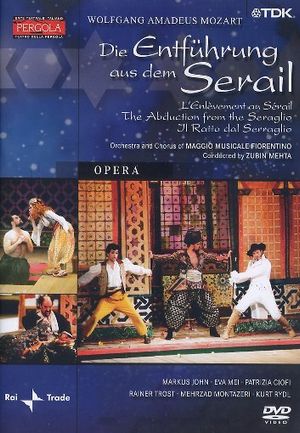
La traviata DVD Reopening of La Fenice DVD Pia de' Tolomei DVD Lucie DVD Die Entführung DVD Opera sampler DVD
Operas on CD La straniera Cherubin Radamisto Pia de' Tolomei Bajazet
Benvenuto Cellini Le nozze L'Orfeo La fedelta premiata Il trittico La rondine
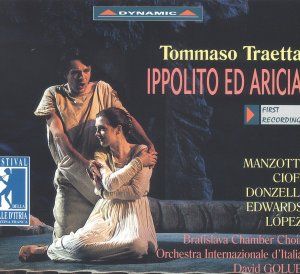
From Martina Franca I Capuleti ei Montecchi Otello Robert le diable Ippolito ed Aricia Il Re & Mese Mariano
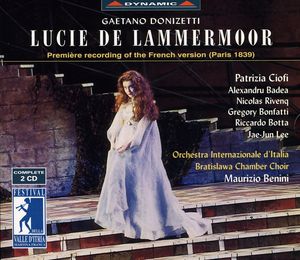
L'Americano Lucie Médée La sonnambula Arias, Duets & Songs Lamenti
Bel Canto Spectacular Combattimento Amor e Gelosia Lettere amorose 3 sopranos Lieder e Songs
Sacred Music Vivaldi Motets Stabat Mater Compilations 30th Anniversary Martina Franca Sampler

Patrizia Ciofi - Live (Various)

Dynamic CDS603
Two-CD compilation: [CD1] 01 Prendi amor (Traetta's Ippolito ed Aricia, Martina Franca 1999); 02 Que je hais le grandeur, 03 En vain j'espère...Idole de ma vie, 04 Robert, toi que j'aime (Meyerbeer's Robert le diable, Martina Franca 2000); 05 Che smania? Ahime! Che affano, 06 L'error d'un infelice, 07 Assisa a piè d'un salice, 08 Deh calma o ciel (Rossini's Otello, Martina Franca 2000); 09 A questo nappo, 10 Sposo ah tronca, 11 Ah di Pia che muore (Donizetti's Pia de' Tolomei, Venezia 2005); [CD2] 01 Sempre in quei cari occhietti, 02 Ah bellina mi piacete (Piccinni's L'Americano, Martina Franca 1996); 03 Qui parle dans la nuit (Massenet's Cherubin, Cagliari 2006); 04 Il faut partir, 05 Par le rang et par l'opulence, 06 Salut à la France (Donizetti's La fille du regiment, Genova 2005); 07 O solinghi recessi, 08 Tutto qui parla ognor, 09 Ma ciel s'ei mai perì, 10 D'una madre disperata, 11 Deh mira l'angelo, 12 Con qual gioia le catene (Meyerbeer's Il crociato in Egitto, Venezia 2007); 13 E strano, 14 Ah fors'è lui, 15 Sempre libera (Verdi's La traviata, Venezia 2004).
To be released Feb 2009.
REVIEWS:

" Chaque répertoire - du baroque au bel canto en passant par le grand opéra français et Verdi - est ici abordé avec conviction, sincérité et une connaissance du(es) style(s) qui font de cette musicienne l'une des plus performantes de sa génération." Forum Opera

Lamenti (Various)

Virgin 5190442
Patrizia Ciofi (soprano), Rolando Villazón (tenor), Topi Lehtipuu (tenor), Marie-Nicole Lemieux (alto), Laurent Naouri (bass-baritone), Christopher Purves (baritone), Natalie Dessay (soprano), Simon Wall (tenor), Véronique Gens (soprano), Joyce DiDonato (mezzo), Philippe Jaroussky (countertenor); Emmanuelle Haim (conductor), Le Concert d'Astrée.
01 Hipparco, e di Climene, Lamento d’Egisto; 02 Non havea Febo ancora, Lamento della Ninfa; 03 L’Eraclito amoroso; 04 Lasciatemi morire, Lamento d’Arianna; 05 Superbe colli; 06 Addio Roma; 07 Acate, Ilioneo, Lamento di Enea; 08 Ferma, lascia ch’io parliâ, Lamento di Maria Stuarda; 09 Dure noie, Lamento d’Atamante; 10 Alle ruine del mio regno, Lamento d’Ecuba e Cassandra; 11 Tu se’ morta mia vita, Lamento d’Orfeo.
Patrizia Ciofi sings on tracks 08 and 10.
Released September 2008.
REVIEWS:

"Starry casts of singers aren’t unknown in records of Baroque repertoire. But has any release before Lamenti contained a lineup of golden throats to top the 11 assembled by Emmanuelle Haïm and Le Concert d’Astrée for this excellent programme of 17th-century laments? ... Patrizia Ciofi, a late arrival, successfully walks the same tightrope, scaling her top register with thrilling power in Cavalli’s Mary Stuart lament." Times Online

"This first-class recording provides a fascinating, superbly sung demonstration of the central place that laments occupied in 17th-century Italian secular music, and their ability to create a perfect union between words and mood. Tempestuous mood swings, frequently founded on a ground bass, are the order of the day, whether in Monteverdi's Lamento della Ninfa or Barbara Strozzi's more quietly sorrowful L'Eaclito amoroso. Rolando Villazón gives a magnificently high-octane performance of an extract from Cavalli's L'Egisto, as does Patrizia Ciofi of Carissimi's compelling setting of Mary Stuart's vituperative valediction from the scaffold." Daily Telegraph

"Patricia Ciofi qui après avoir imposé son chant embrasé et incarné chez les auteurs du bel canto romantique, se dévoile époustouflante en Maria Stuarda de Carissimi, dont le Lamento de plus de 9 mn, souligne l'art du souffle, l'éclat des aigus déchirants, et la vérité dramatique. [...] Ajoutez à cette succession jubilatoire de tempéraments vocaux, la finesse d'un continuo cristallin, doué de fulgurances expressives sculptées dans la mesure et la nuance. Récital lyrique baroque de première importance: Emmanuelle Haïm nous régale. Disposions-nous dans le passé d'une telle palette de chanteurs désormais rompus aux délices du bel canto baroque?" Classique News

"Superbe Patricia Ciofi, redoutablement altière dans le Lamento di Maria Stuarda de Carissimi, au chant nuancé, âpre et désorienté à l'image de la reine déchue, sculptant chaque syllabe, lançant chaque mot comme un défi à la face d'un monde qui l'a outragée. La projection est droite, solide, presque dédaigneuse et soudain la soprano se laisse fléchir un instant, révèle la femme blessée, oublie un vibratello qui dit la souffrance derrière l'hermine déchirée." Muse Baroque

"Un beau disque thématique. [...] Ces héros et héroïnes qui se lamentent sur leur condition, s’en prennent à leur destin, puis acceptent finalement leur sort avec dignité, sont tout autant magnifiés par Cavalli (La Didone) où l’élocution incisive et la sensibilité de Topi Lehtipuu font merveille, que par Carissimi (Lamento di Maria Stuarda) qui permet à Patrizia Ciofi/Reine d’Ecosse, de sortir ses griffes dans un déferlement d’aigus piqués, avant de s’incliner en martyre et de marteler son innocence bafouée « Villipesa innocenza »." Forum Opera

"Jeder dieser Stars fasst die Kunst des Lamento durchaus unterschiedlich auf. So kann der Hörer die schwierige Wahl treffen, wer denn nun am schönsten leidet. Für mich ist dies Patrizia Ciofi, die eine angenehme Mischung aus Emphase und Kunstfertigkeit zu bieten hat, dabei ihre Partie mit vielen Schattierungen und Stimmungsumschwüngen zu variieren weiß." Musik an sich

La straniera (Bellini)

Opera Rara ORC38
Patrizia Ciofi (Alaide), Mark Stone (Il barone di Valdeburgo), Darío Schmunck (Arturo), Enkelejda Shkosa (Isoletta); David Parry (conductor), London Philharmonic Orchestra.
Released September 2008.
REVIEWS:

"In the title role of Opera Rara's new recording, Italian soprano Patrizia Ciofi brings the composer's strong characterisation of Alaide to the fore, and triumphs. At times, she's clearly taxed to her limits in a role that is rather demanding for her equipment, but her beauty of tone and absolute commitment make the numbers in which she appears utterly compelling." MusicalCriticism.com

"Résumons en disant que Ciofi y est excellente. Ce dès sont entrée – cd 1, plage 5 – avec d’extraordinaires trilles noyés de brume, comme parcourus d’éclats lunaires; et jusqu’à son exceptionnel 'A sei pago' final. Ici, la voix est pleine, posée, reposée – ce n’est pas toujours le cas – avec cette espèce de lumière sombre, cette pulvérulence du timbre, cette poésie noire qui sont un peu sa marque de fabrique, diffractant le rôle en une galaxie de poussières de sons et de mots. Et toujours ces irisations, cette technique parfaitement assumée qui fait que – et c’est parfois étonnant – l’artiste paraît à sa place un peu partout. Surtout le rôle, relativement central, ne surexpose pas ce qui excite souvent les détracteurs de Ciofi – qui s’accrochent à ce qui leur reste, la femme, faillible comme tout un chacun, puisque l’artiste, elle, est toujours intègre – en l’occurrence son aigu, qui ici comme souvent pourra paraître induré même s’il est, lui aussi, crânement assumé. [...] Un coffret nécessaire – ne serait-ce que parce que c’est le premier studio de l’œuvre – pour qui voudra vraiment connaître Bellini et le bel canto romantique." Forum Opera

Bel Canto Spectacular

DECCA 478 0315
Juan Diego Flórez (tenor), Patrizia Ciofi (soprano), Placido Domingo (tenor), Anna Netrebko (soprano), Daniela Barcellona (mezzo), Mariusz Kwiecien (baritone); Daniel Oren (conductor), Orquesta de Valencia.
01 Amici miei, che allegro giorno; 02 Vieni, fra queste braccia; 03 La maitresse du roi? Ange si pur; 04 Venti scudi; 05 Una furtiva lagrima; 06 Linda, Linda...Da quel di che t'incontrai; 07 Linda! Si ritiro... Se tanto; 08 Di che son reo? D'alma celeste; 09 Partir degg'io... T'amo qual s'ama un angelo; 10 Ah vieni, nel tuo sangue; BONUS Tornami a dir.
Patrizia Ciofi sings on track 06 and the bonus track.
Released July 2008.
REVIEWS:

"'Da quel di' from Donizetti's Linda di Chamounix with Patrizia Ciofi is the highlight of the disc. The singers are well matched on every level, as their pairing on Decca's DVD of La fille du régiment shows, and the combination of their light, flexible voices works equally well here. In recent times, Ciofi has been moving more towards the spinto roles, and the way she uses all kinds of expressive devices seems to have encouraged him likewise to find a warmer, more ardent sound in his delivery." MusicalCriticism.com

"Patrizia Ciofi, is especially welcome as the heroine of Linda di Chamounix, singing with a veiled beauty." Times Online

"There are two pieces from Linda di Chamounix - the first provides one of the best duets of the album, with Italian soprano Patrizia Ciofi, whose coloratura rivals Flórez’s and whose voice partners his to perfection." MusicWeb-International

"Soprano Patrizia Ciofi has a most beautiful quality to her voice. It has what I would term the “Old School” sound, a completely individual timbre like Scotto, or Olivero, or Gencer. The duet from Linda di Chamounix is as lovely and as exciting as the famous one from Lucia di Lammermoor (“Verrano a te sull’aure”). It should be better known. Pavarotti and Sutherland recorded it, and this performance is of equal distinction. The music is again marked by Donizetti’s brilliant orchestration and soaring melodies. It lifts my heart and makes me want to sing just hearing it. You will especially enjoy this duet. It is really lovely." ConcertoNet

Don Pasquale (Donizetti) DVD

Bel Air Classiques BAC033
Patrizia Ciofi (Norina), Simone Alaimo (Don Pasquale), Norman Shankle (Ernesto), Marzio Giossi (Dr. Malatesta); Evelino Pido (conductor), Chorus of the Grand Theatre de Geneve & Orchestre de la Suisse Romande.
Recorded "live" in May 2007; released in Mar 2008.
REVIEWS:

"Daniel Slater's production ... is so fresh and delightful, the DVD version stands up to repeated viewings. There is no dreary mugging or commedia dell'arte shtick in this inventive and witty take on the story of an aging gentleman who, seeing happy couples everywhere, hopes for his own last chance at love. [...] Francis O'Connor's precise and elegant sets and 1940s costumes would steal the show were it not for the high-level acting from an exemplary ensemble cast. Simone Alaimo heads the cast, with clear and elegant singing and a dimpled cheerfulness that deflates totally after Norina slaps him. [...] Tenor Norman Shankle's singing sounds effortless and sweet, and his Ernesto is not too serious to don a gaucho outfit and hire guitar players to serenade Norina. Both Shankle and Patrizia Ciofi, the Norina, have rounded, mellow voices that don't obliterate ensembles; the close harmony of their nocturnal duet, "Tornami a dir che m'ami," is beautifully blended. Ciofi is such a natural in the bel canto repertory, it's easy to overlook her technical skill and vocal allure. Here she takes her place among equally skilled colleagues in an adorably enjoyable performance." Opera News

"Vocally, the evening was dominated by Patrizia Ciofi and Simone Alaimo, its Norina and Pasquale. Alaimo, who took a fall during the dress rehearsal, was announced as having residual back pain on May 22, but his bass voice sounded in splendidly ripe form; he relished the text and captured just the right degree of pathos as the old philanderer saw his dreams of marriage crashing around him. Ciofi, with her veiled, tearful soprano, was not obvious casting for a role generally assigned to sparkling soubrettes, but she made a strong case for seeing the role as a virtuoso dramatic tour de force. She moved swiftly from mock tragedy and pointed scheming to "wifely" nagging and rejoiced in the exultant lyricism of her music with Ernesto while managing the coloratura corners of the score with the utmost dexterity." Opera News stage review

"'Triomphale Patricia Ciofi.' Vocalement comme scéniquement, la soprano italienne envahit la scène. Comédienne virevoltante, triomphale, elle s’empare de son rôle avec une drôlerie à en faire oublier qu’elle chante admirablement bien. Aux dépens d’une voix relativement peu puissante, elle oppose une agilité vocale et une clarté de diction remarquables. Son jeu, ses mimiques, ses postures excessives racontent ses états d’âme presque mieux encore que les mots. Sans jamais oublier l’expression belcantiste, elle est aussi charmante et amoureuse de son Ernesto que détestable et capricieuse vis-à-vis du pauvre Don Pasquale." ResMusica stage review

"Quand deux chanteurs de la trempe de Patrizia Ciofi et Simone Alaimo se retrouvent sur un plateau, la rencontre ne peut provoquer que des étincelles, voire, selon les cas, une gifle d’anthologie! Et c’est exactement ce qui se produit sur la scène du Grand Théâtre de Genève, à l’occasion d’une nouvelle production de Don Pasquale, où ce duo de choc porte littéralement la représentation. Chez Patrizia Ciofi, on admire l’agilité et la souplesse de la voix ainsi que l’aisance dans les vocalises, même si la soprano italienne a besoin de quelque temps pour «se chauffer». Après avoir ébloui les scènes lyriques du monde entier avec sa Lucia, elle prouve désormais qu’elle a suffisamment d’abattage pour se lancer dans des rôles comiques. Simone Alaimo ne lui cède en rien, avec son chant raffiné, tout en nuances, et une diction remarquable." ConcertoNet stage review

"Qu'on aime ou pas, le jeu de Patricia Ciofi, son incarnation mérite largement d'être vue et écoutée. [...] Dans les décors stylés puis design (mondrianesques) de Francis O'Connor, la Norina de Patricia Ciofi apporte ainsi la ciselure de son articulation belcantiste, teintée de son expérience des grandes héroïnes tragiques donizettiennes, de Lucia à Amina, qu'elle a incarnées sur scène. L'interprète a-t-elle pour autant l'esprit du rôle? La question mérite d'être posée, tant il y manque ce piquant et cette insolence moqueuse qui fondent le personnage féminin. C'est peut-être aussi un problème de voix (souvent serrée, limitée, sans vraie respiration...)." Classique News

"L’opéra de Donizetti est un régal pour les yeux et les oreilles. [...] Quant à la distribution, elle est dominée par un couple phare: Patrizia Ciofi en Norina de haut vol et Simone Alaimo en Don Pasquale de grande classe. Toute cette équipe, entraînée dans un joyeux tourbillon de la scène à la fosse, dégage un vif plaisir musical et théâtral. [...] Patrizia Ciofi est la femme du rôle. Même si son grain de voix est plus cerise que citron et son jeu plus intelligent que capricieux, la maturité qu’elle ajoute à Norina ne lui en donne que plus de force. Aigus de feu et vocalises assassines lancées comme des armes par cette maîtresse chanteuse." La Tribune de Genève stage review - 24 May 2007

"Patrica Ciofi triomphe de sa voix agile, claire et onctueuse (magnifiques vocalises) et forme un tandem hors pair avec Simone Alaimo, impeccable d'aisance et de nuance en Don Pasquale." Le Temps stage review - 24 May 2007

"Quant à Norina. Ah… Ciofi faisait ses débuts à Genève dans un rôle qui n’est pas, non plus, le plus franchement périlleux du répertoire, tous maîtres confondus. Il n’y a pas de tour de force à réaliser une bonne Norina ; au moins vocalement. De ce point de vue-là, pas de déception. Le timbre est ce qu’il est ; avec ses tensions, ses âpretés ; cette espèce de strain dans l’aigu qui fait, aussi, que l’on se demande confusément si ce n’est pas le dernier que la dame pourra fournir. Mais, miracle, elle y arrive à chaque fois. Il y en a qui aime – comme moi – et d’autres qui détestent. Donc vocalement, c’est un accessit. Et scéniquement, Ciofi ne se défend pas plus mal ; dans les limites qui lui sont fixées. Sa petite femme est sanguine, rouée juste ce qu’il faut ; pimpante, piquante. Et quels yeux ! Qui réactivent des souvenirs moites de mélos façon Bette Davis ! Bref, des lignes et de la ligne – vocalement, s’entend." Forum Opera

Il crociato in Egitto (Meyerbeer) DVD

Dynamic 33549
Patrizia Ciofi (Palmide), Michael Maniaci (Armando), Marco Vinco (Aladino), Laura Polverelli (Felicia), Fernando Portari (Adriano); Emmanuel Villaume (conductor), Orchestra and Chorus of Teatro La Fenice di Venezia.
Recorded in January 2007; released January 2008.
REVIEWS:

Coming soon.
See stage reviews here.

Combattimento (Monteverdi)

Virgin 3634022/3633502
Patrizia Ciofi (Clorinda), Topi Lehtipuu (Tancredi), Rolando Villazón (Testo); Emmanuelle Haïm (conductor), Le Concert d'Astrée.
01 Il combattimento di Tancredi e Clorinda. Arias/duets: 02 Interotte speranze, eterna fede, 03 Ecco di dolci raggi il sol armato, 04 Si dolce e'l tormento, 05 Ohime ch'io cado, ohime, 06 Perche se m'odiavi, 07 Et e pur dunque vero, 08 Quel sguardo sdegnosetto, 09 Maledetto sia l'aspetto, 10 Piu lieto il gurado, 11 Tempro la cetra, 12 Tornate, o cari baci, 13 Eri gia tutta mia.
Patrizia Ciofi sings in tracks 01, 05, 08.
Released November 2006.
REVIEWS:

"Cult diva Patrizia Ciofi conveys with uncanny power Clorinda’s heavenly transfiguration in the Combattimento’s closing measures, and turns in a swooning, lascivious “Ohimè ch’io cado, ohimè.” " Time Out NY

"De son côté [Villazon], prenant les risques de l'embrasement et de la vitalité fragile, taquine et diamantine, Patricia Ciofi hisse très haut l'ivresse extatique et sensuelle du chant Montéverdien (Ohimè ch'io cado...) Superbe!" Classique News Jan 2007

"Patrizia Ciofi est idéale pour la musique baroque car la petite fêlure de sa voix ajoutée à un léger voile apportent une faiblesse et une douceur à son chant. Elle chante plusieurs madrigaux dont “Ohimè ch’io cado, ohimè”. Elle semble flâner d’une note à l’autre avec une légèreté parfois brisée par des accents qui mettent en valeur un sentiment. En revanche, ses premiers “ohimè” ne sont pas de très bon goût car elle exécute des vocalises descendantes en glissando. “Quel sguardo sdegnosetto” est nettement plus convaincant car elle présente de jolies couleurs et elle dessine bien un jeune garçon espiègle et frivole." ConcertoNet Jan 2007

"Patrizia Ciofi, avec sa voix délicieusement voilée, très à l'aise dans le plus pittoresque et caractéristique «Ohimè ch'io cado, ohimè»." Classica/Répertoire - Nov 2006

"[Ciofi] seems to apply a rather uniform swooping and cooing manner to all of her items on the disc." MusicWeb - Jan 2007

Reviews also appeared in the following publications:
Gramophone - February 2007 p.82
American Record Guide - May/June 2007 Vol.70 No.3 p.129
Opera Actual (Barcelona) - No.98 marzo 2007 p.92

Chérubin (Massenet)

Dynamic CD:CDS508 and DVD:33508
Michelle Breedt (Chérubin), Patrizia Ciofi (L'Ensoleillad), Carmela Remigio (Nina), Giorgio Surjan (Il filosofo); Emmanuel Villaume (conductor), Orchestra e Coro del Teatro Lirico.
Recorded "live" in Cagliari, Jan 2006; released Sept 2006.
REVIEWS:

"In this brilliant performance from Cagliari everything is just right. High quality youthful voices give an ebullient interpretation. Everyone relishes the texts, with clear diction and real dramatic involvement. Breedt is vocal peaches-and-cream, even through the range, with a delicate humanity that is tasteful and charming. Matching Breedt note for note in the vocal beauty department is Remigio. When they join voices for the final duet the result is pure vocal magic. Ciofi's voice is similar in coloring and just as attractive. What a trio in Der Rosenkavalier these three would make! Surian is a concerned, resounding Philosopher. The entire cast, chorus, and orchestra are nothing short of spectacular. The orchestra is quite splendid in tone and precision, and Villaume brings out their warm, romantic tone to its fullest, along with an ebullience that enlivens the show. The recorded sound is spectacular. [...] This is one of the most ear-beguiling operas and performances to grace my ears in quite a while. So indulge your romantic side and give it a listen." American Record Guide review of CD

"La morale de l’histoire est évidente : Chérubin se métamorphose à grands pas en Don Juan. Equipe peu francophone mais qui soigne sa diction, élément essentiel dans une œuvre où Massenet émaille des numéros musicaux brillants de brèves sections parlando. Michelle Bredt respire avec générosité les magnifiques ariosi que lui réserve Massenet, écrits très cantabile. Patrizia Ciofi produit un grand numéro de virtuosité et de charme en Ensoleillad, les comprimari sont époustouflant de vie, les décors délicieusement kitsch, la mise en scène foisonnante : deux heures de plaisir sans mélange." Concert Classic review of DVD

"Michelle Breedt es un Chérubin creíble, que aguanta muy bien el primer plano y que sabe traducir con acierto los sentimientos de su alma perpetuamente enamorada. Patrizia Ciofi –qué gran cantante– es una estupenda L’Ensoleillade –la bailarina del Teatro Real amante del Rey de España– y Carmela Remigio una Nina convincente." Diverdi review of DVD

"An evening of continuous entertainment by a cast of singers, who are also excellent actors, that play their parts to the full. Worthy of mention is the verve of the protagonist Michelle Breedt, Patrizia Ciofi's scintillating Ensoleillad, Carmela Remigio's touching Nina, the wise sarcasm of the Philosopher by Giorgio Surian, and Bruno Lazzaretti's very entertaining Duke. Emmanuel Villaume made a fine show at conducting the choir and orchestra. The performance was a resounding success." Il Giornale della Musica stage review

"Brava anche Patrizia Ciofi nei panni dell’Ensoleillad (Soprano). Voce sempre perfettamente in maschera (e già dalle prime battute si fa sentire) con un timbro delizioso e scintillante. Anche lei bravissima nel suo personaggio: ama, seppur per una sola notte, Chérubin ed il giorno dopo lo ignora senza scrupoli. Più che buona l’esecuzione della magnifica aria “Vive Amour Qui Rêve” - l’amore è un sogno e dopo quella notte, sarà solo un ricordo." Operaclick stage review

La fille du régiment (Donizetti) DVD

Universal 074 3146 7
Patrizia Ciofi (Marie), Juan Diego Flórez (Tonio), Nicola Ulivieri (Sulpice), Francesca Franci (La Marquise de Berkenfeld), Maurizia Burlando (La Duchesse de Crakentorp), Dario Benini (Hortensius); Riccardo Frizza (conductor), Orchestra e Coro del Teatro Carlo Felice.
Recorded in February 2005; released in September 2006.
REVIEWS:

"This is the performance we've been waiting for. It's precisely the right size, the singers are young, in their primes, and come close to looking their parts. And it's funny without resorting to slapstick. [Ciofi] is a superb actress and an almost flawless singer, with impeccable technique and pitch, great musical intelligence, and exquisite phrasing. The voice is lovely and round in the middle, the top is clear and exciting, with a sharpish edge, and the bottom of the voice is well-integrated. Here, she becomes Marie--loving, sweet, melancholy, vivacious, and spunky by turns." Classics Today review of DVD

"Ciofi gives one of the most dazzling live performances of any role in any opera currently available on DVD. She runs the gamut of emotions, from heartbroken to overjoyed. Similarly, her vocal prowess is such that the coloratura arias are astoundingly dexterous, whilst the more lyrical and sustained items are beautifully paced and immaculately intoned. [...] She almost steals the show from [Florez], in fact, because the role of Marie is considerably longer and arguably more psychologically complex than that of Tonio." musicOMH.com

"Patrizia Ciofi restores Marie to her proper, central place with a performance of tireless invention, deft characterization and, almost incidentally, exquisite singing. Unblemished bel canto technique allows her to take on the inconspicuously large role, with its dauntingly frequent changes of character, with a freedom that becomes more bewitching with every scene." Bay Area Reporter

"Patrizia Ciofi is one of the best bel canto sopranos around, with her warmly expressive sound and expansive phrasing. In cantabiles such as Maries Act I "II faut partir" and "Par le rang et par l'opulence" in Act II, Ciofi spins the long lines with care and control, using cadenzas and high notes effectively within the lyric framework of the vocal writing. In more lighthearted moments, such as "Chacun le sait" and the frothy "Salut a la France," close camerawork reveals her pressured technique, but she's a good enough actress to pull off the role, and her relaxed antics in the lesson scene are genuinely funny." Opera News Feb 2007

"Ciofi is a wonderful Marie. Her voice is warm and rich in the midrange, and brilliant and flexible at the top. She dashes off plenty of coloratura fireworks, yet she's lyrical and moving in the tender moments and meltingly sympathetic in act II, when forced to marry the duke. Best of all, both Ciofi and Florez can act, and they are blessed with abundant stage presence." Fanfare Mar/Apr 2007

"Dans le répertoire comique, ou tout du moins léger, il faut un certain envol de la part des interprètes pour que l’intrigue nous passionne. Comment alors ne pas fondre devant la délicieuse Patrizia Ciofi ? Elle possède tout d’abord l’abattage vocal, la légèreté d’esprit du personnage. Mis à part quelques aigus un peu tirés, la voix est superbe, livrant l’émotion si difficile à restituer de « Il faut partir » ; juste après le morceau de bravoure des neuf contre-ut du ténor enflammant théoriquement le public, il est ardu de passer à un air plus élégiaque. Le legato de Mlle Ciofi est alors là à son comble, et que l’on a plaisir à retrouver aussi parfait dans l’aria finale, « Quand le destin ». La leçon de chant du début du deuxième acte est d’une drôlerie irrésistible : l’exaspération de Marie est maximale, elle chante faux, et c’est peut être la première fois que l’on se délecte des fausses notes d’une chanteuse!" Resmusica review of DVD

"Patrizia Ciofi si conferma con la sua "Marie" come una delle più spiccate personalità della scena lirica attuale: intonazione impeccabile, straordinaria espressività di un fraseggio prontamente mutevole dalla malinconia alla vivacità e viceversa, presenza scenica disinvolta e coinvolgente, ne svelano in ogni momento un'intelligenza musicale e scenica di assoluto livello." Il secolo XIX stage review

"Marie ha avuto la voce bella e duttile, la presenza scenica spiritosa e gradevole di una Patrizia Ciofi in grande forma." La Repubblica stage review

"La "Marie" di Patrizia Ciofi è anche lei superlativa: ciò che rischia di offuscare lievemente la prova (acuti vagamente affaticati, ma un pizzico di fatica anche neìl'emissione.. . Forse è in un periodo di superiavoro?), viene supplito dalla personalità scenica assolutamente catturante (a livello di.. . "a me gli occhi!" Accentra persino quando c'è Florez in scena) e da una musicalità sopraffina: Ciofi grande,grande musicista." Il corriere mercantile stage review

"Sicuramente ci troviamo di fronte ad un’artista dotata di ottima musicalità, ma alcuni limiti tecnici sono evidenti e pongono un’ipoteca sull’effettivo rendimento espressivo. Si ha l’impressione, in particolare, che la cantante sia sempre al limite delle proprie possibilità, soprattutto per una respirazione piuttosto affannosa e un continuo sforzo per la ricerca del suono, che la costringono ad improbabili atteggiamenti del viso e del corpo. Soprattutto nella prima parte dell’esecuzione si notano attacchi un po’ gutturali e qualche problema di intonazione; la voce, che già naturalmente non è di eccelsa qualità, si rivela spesso opaca, come velata. In ogni caso i momenti migliori sono quelli più elegiaci - in particolare le due arie ("Il faut partir!" e "Par le rang et par l'opulence"), eseguite con appropriata espressività - e soprattutto la scena della “lezione di canto”, recitata e cantata con simpatia e grande ironia." Operaclick stage review

"Um die Zukunft des Belcanto-Throns braucht man sich indes keine Sorgen zu machen - gegenwärtig gibt es in diesem Fach eine Reihe herausragender junger Sängerinnen und Sänger. Patrizia Ciofi zieht in der Titelpartie von «La fille du régiment» ebenfalls alle Register stimmlichen Könnens: Ihr Sopran wird schlank und ebenmässig, in den Koloraturen virtuos geführt, und an ausdrucksvollen Modulierungen herrscht kein Mangel." Neue Zürcher Zeitung review of DVD

Reviews also appeared in the following publications:
Diapason - No.542 décembre 2006 p.115
International Record Review - December 2006 p.77
American Record Guide - March/April 2007 pp.242-249
Opera Actual (Barcelona) - No.95 noviembre 2006 p.76
Opéra Magazine - No.12 novembre 2006 pp.80-81

I Capuleti ei Montecchi (Bellini)

Dynamic CD:CDS504 and DVD:33504
Patrizia Ciofi (Giulietta), Clara Polito (Romeo), Federico Sacchi (Capellio), Danilo Formaggia (Tebaldo), Nicola Amodio (Lorenzo); Luciano Acocella (conductor), Orchestra Internazionale d'Italia.
Recorded in August 2005; CD released in May 2006; DVD in Sep/Oct.
REVIEWS:

"Not only does [Patrizia Ciofi] look the part, she acts it with subtlety, grace, and great poignancy. Her singing also is lovelier than I've ever heard it; she spins Bellini's long melodies with gorgeous legato and exclaims with great expression." Classics Today review of DVD

"The performance is dominated by Patrizia Ciofi, who once again demonstrates that she has few rivals today in this repertoire with her uncanny ability to infuse her singing with emotion." CultureKiosque review of DVD

"Patrizia Ciofi s’impose dès son récitatif d’entrée, de son timbre pur, égal et pourtant comme voilé, de cette sensibilité, cette chaleur avec lesquelles elle aborde tout rôle! Elle est ici entièrement au service du miracle bellinien : dans la sublime romance d’entrée de Giulietta, où la magie de Bellini suspend notre existence dans des sphères impalpables et mystérieuses, aussi bien que dans l’air du second acte, transposé vers le grave, et donnant à Giulietta une présence plus réelle." Forum Opéra review of CD

"La Giulietta de Patrizia Ciofi... La beauté un rien fragile de son timbre, son savoir-faire technique et stylistique ainsi que l’intensité émotionnelle de son chant font d’elle une représentante idéale du rôle." ResMusica review of CD

"Il soprano senese, delicatissima, quasi fragile nei flebili accenti, svettante e pur sempre limpida nei momenti più accesi del dramma è andata oltre le aspettative, incantando il pubblico con la sua voce suadente. Patrizia Ciofi ha fatto trattenere il respiro, interpretando alla grande le elegiache e accattivanti melodie belliniane e i momenti di drammatica intensità. Bravissima anche nei recitativi accompagnati, sicuramente frutto di eccezionale sensibilità artistica, ma anche di un accurato lavoro di preparazione che le fa onore. Il pubblico l’ha ripagata con applausi a scena aperta e con ripetute chiamate sul proscenio." Operaclick stage review

Reviews also appeared in the following publications:
Gramophone - November 2006 p.119 (DVD)
Fanfare - Vol.30 No.2 November/December 2006 pp.126-127 (audio)
Diapason - No.542 décembre 2006 pp.114-115 (DVD)
International Record Review - June 2006 p.76, p.78 (audio)
International Record Review - October 2006 pp.80-81 (DVD)
American Record Guide - Sep/Oct 2006 Vol.69 No.5 p.86 (audio)
Opéra Magazine - No.10 septembre 2006 p.78 (audio)
Opéra Magazine - No.18 mai 2007 p.80 (DVD)
L'opera (Milano) - Anno XX N.209 ottobre 2006 pp.74-77 (DVD)
Opera Actual (Barcelona) - No.96 diciembre 2006 p.77 (DVD)

Opera Sampler DVD

TDK DVWW-OPSMPL3
Two-DVD set of highlights from TDK's catalogue of opera recordings. Patrizia Ciofi appears in [track 24] the trio "Cosa sento! Tosto andante" from Le nozze di Figaro; and [track 27] "Prendi, quest’è l’immagine" from La traviata.
Released in February 2006.

Le nozze di Figaro (Mozart) DVD

TDK DVWW-OPNDFF
Patrizia Ciofi (Susanna), Lucio Gallo (Il Conte d'Almaviva), Eteri Gvazava (La Contessa), Giorgio Surian (Figaro), Marina Comparato (Cherubino), Giovanna Donadini (Marcellina), Eduardo Chama (Don Bartolo), Sergio Bertocchi (Don Basilio), Eleonora Contucci (Barbarina), Gianluca Ricci (Antonio), Carlo Bosi (Don Curzio); Zubin Mehta (conductor), Orchestra e Coro del Maggio Musicale Fiorentino.
Recorded "live" in Florence, Oct 2003; released Dec 2005.
REVIEWS:

"Nous ne pouvons que nous réjouir de la parution d’une nouvelle version DVD de la folle journée mozartienne, surtout lorsque celle-ci immortalise la Susanna presque absolue de Patrizia Ciofi, d’un naturel de chant et de jeu absolument confondant." ResMusica review of DVD

"Patrizia Ciofi is a suitably lively Susanna, making the most of the second act aria 'Venite, inginocchiatevi' when she dresses Cherubino in girls’ clothes and singing a lovely 'Deh, vieni, non tardar' with Figaro eavesdropping in the fourth act. She also embellishes the aria discreetly and elegantly." MusicWeb review of DVD

"La simpatica e spiritosa Susanna di Patrizia Ciofi cantava bene, ma senza incantare..." Drammaturgia review of performance, with photos

Reviews also appeared in the following publications:
Opera - November 2006 pp.1384-1386
Fanfare - Vol.29 No.5 May/June 2006 pp.270-271
Orpheus - März+April 2006 S.68, S.69
American Record Guide - May/June 2006 pp.243-246
Opéra Magazine - No.6 avril 2006 p.76

Radamisto (Handel)

Virgin #5456732
Joyce Di Donato (Radamisto), Patrizia Ciofi (Polissena), Maite Beaumont (Zenobia), Dominique Labelle (Fraarte), Laura Cherici (Tigrane), Zachary Stains (Tiridate), Carlo Lepore (Farasmene); Alan Curtis (conductor), Il Complesso Barocco.
Recorded in 2003; to be released in November 2005.
Sample clips (each 0'30"). Polissena's arias are heard on disc 1 tracks 2, 6, 22; disc 2 track 20; and disc 3 track 8.
REVIEWS:

"The singing is excellent throughout. Patrizia Ciofi continues to make a name for herself as a soprano equally comfortable in the brilliant divisions of Baroque music and as Violetta in Verdi's La traviata." Classical Net

"Polissena, Patricia Ciofi se joue des redoutables et virevoltantes difficultés de sa partie et l’engagement de cette tragédienne est total dans sa situation d’épouse délaissée." ResMusica

"Virtuose toujours impeccable, Patrizia Ciofi sait donner une réelle consistance au texte. Pleine de hargne dans Barbaro, partiro, de miel dans Dopo torbide procelle, et de larmes dans Tu vuoi ch'io parto, sa Polissena reste néanmoins un rien en retrait par rapport à l'investissement dramatique et musical dont la soprano italienne a fait preuve depuis cet enregistrement, effectué en 2003." Forum Opera

"Angeführt wird das Solistensextett qualitativ von hohem Niveau Joyce DiDonatos und Patricia Ciofis, die beide an die Leistungen ihres gemeinsamen Händel-Albums bei Veritas anknüpfen können (siehe die Rezension bei klassik.com). Ihnen gelingt in den Soloszenen genau jene charakteristische Ausdrucksstärke, die Curtis mit seinem Ensemble in der Begleitung schuldig bleibt. Die leuchtenden, sicher gesetzten Höhen des agilen Soprans der Ciofi und die satte Wärme des körperreichen Mezzosoprans der DiDonato setzen die stärksten Akzente in dieser Produktion." Klassik.com

"The supporting cast is superb, headed by Maite Beaumont's plush-toned Zenobia, Patrizia Ciofi's diamantine Polissena and Zachary Stains's nasally villainous Tiridate, the wicked brother-in-law who lusts after Zenobia. Curtis's Handel is immaculate..." Sunday Times

"Patrizia Ciofi, as Polissena, starts things off vocally with a stratospheric aria, ravishingly sung, that sets the stage for the uniformly fine singing to come." Bay Area Reporter

Reviews also appeared in the following publications:
Gramophone - December 2005 p.115, p.117
Diapason - No.530 novembre 2005 p.97
BBC Music Magazine - December 2005 p.78
International Record Review - December 2005 p.70
Opera Actual (Barcelona) - No.86 diciembre 2005 p.86

Pia de' Tolomei (Donizetti)

Dynamic CD:CDS488 & DVD:33488
Patrizia Ciofi (Pia), Dario Schmunck (Ghino degli Armieri), Andrew Schroeder (Nello della Pietra), Laura Polverelli (Rodrigo), Daniel Borowski (Piero); Paolo Arrivabeni (conductor), Orchestra and Chorus of Teatro la Fenice.
Recorded April 2005; CD released August 2005, DVD in September.
REVIEWS:

"The star is Patrizia Ciofi as Pia. She delivers a specific, focused reading, beautifully sung and filled with as much textual and tonal nuance as the score allows. Her voice has gained body in the middle and the top still gleams." ClassicsToday review of CD

"Patrizia Ciofi ha il merito di affrontare con straordinaria grinta la difficoltosa parte di Pia de’ Tolomei rendendo un’interpretazione molto partecipe, in grado di ravvivare il personaggio e mostrandosi sempre “in crescendo” durante lo svolgimento dell’opera, sino a rendere un finale di altissima intensità emotiva. Vocalmente sfoggia bellissimi colori e sfumature anche se qualche acuto risulta a volte un po’ “stiracchiato”. Nell’emissione si avverte una certa “velatura” che rende a tratti la voce un po’ opaca, tuttavia senza inficiare l’esito complessivo di una buona prestazione." OperaClick review of CD

"Ciofi pretty well storms the musical heavens by herself. She is not only dramatic-a pitiful, abused soul-but she sings like the proverbial angel, firmly in control of the long legato lines, soaring with ease, taking the coloratura in stride." American Record Guide review of CD

"This commendably faithful version of the opera reveals an abundance of melodic inspiration and the celebrated Italian soprano Patrizia Ciofi is outstanding in the title role." ClassicalArchives review of DVD

"Patrizia Ciofi as Pia conveys the role’s many situations most convincingly. Hers is an outstandingly distinguished portrayal in the intensity of her acting and singing. She does not have quite the security in the florid passages of Majella Cullagh in the Opera Rara issue, but more than compensates in the more dramatic scenes. This is nowhere more evident than in the pivotal scene when Pia convinces Ghino of her innocence and persuades him to go to her husband and reveal the truth as to her nocturnal visitor. In this scene Patrizia Ciofi’s phrasing, expression and colouring are a delight. Given the intensity and conviction of her portrayal the odd moment of unsteadiness is readily forgiven." MusicWeb review of DVD

"Patrizia Ciofi è di Pia l’interprete ideale: vocalista inappuntabile, sa innervare il suo canto d’una febbrile emozione, il cantabile è intenso e vibrante, la coloratura sempre espressiva, impressionante nella cabaletta finale, in cui si fa sospiro e fremito della morente nobildonna senese." Gli Amici della Musica review of DVD

"La célèbre Patrizia Ciofi est une somptueuse Pia, résumant toutes celles qui l'ont précédée. Elle possède en effet le timbre à la fois accrochant ou incisif comme celui de Jolanda Meneguzzer ou de Lois McDonall, mais imprégné également de cet aspect angélique pleinement et incroyablement offert par Lella Cuberli. [...] La valeureuse cantatrice nous semble posséder l'intelligence du rôle, décrit par elle dans l'entracte comme écrasant. Sa technique pleinement efficace lui permet non seulement ces magnifiques aigus et suraigus piani à couper le souffle, mais également de varier joliment les reprises..." Forum Opéra review of broadcast, with photos

"Et surtout, Patrizia Ciofi dessine une Pia toute de vulnérabilité, de sensibilité et d'émotion à fleur de peau, avec cette couleur "pathétique qui fait merveille dans beaucoup d'héroines belcantistes. Dans le feu d'une captation sur le vif, tout n'est pas aussi parfait, bien sur, que cela aurait pu l'etre en studio, mais quelle science du clair-obscur, quelle assurance dans le vocalises!" Opéra

"Dalla Ciofi, sempre tenace nel leggere pagine morte per riportarle a nuova vita, ci aspettavamo colorature trasfigurate in lirici sospiri, prolungate interiezioni passionali, accenti 'au confessional du coeur' e invece si sono colti, al di là della meccanicità, più i suoi limiti (sforzi di emissione, scarsa percezione delle parole)." Giornale della Musica review of performance

"Patrizia Ciofi, Pia, parte un po’ affaticata, tesa, con un certo sforzo in acuto e con la respirazione non del tutto a posto, tuttavia cresce già nel corso del primo atto sino ad un finale di grandissima intensità. Al di là di tutto, la Ciofi resta una cantante da vedere; splendida attrice, grande caratterizzatrice dei suoi personaggi, scenicamente sempre convincente. Alla fine per lei applausi meritatissimi." OperaClick review of performance, with photos

"Inoltre alla Fenice si poteva ora disporre della giusta protagonista, Patrizia Ciofi dolcissima e lirica Pia, com'è la sua musica, quella di un'innocente condannata a morire." La Stampa review of performance

"Patrizia Ciofi, ormai una diva mondiale, impersona la protagonista con tutta la finezza della sua fonazione e del suo timbro; sebbene paia più preoccupata dei virtuosismi che della meravigliosa linea melodica." Corriere della Sera review of performance

"Patrizia Ciofi meisterte ihre Titelpartie bravourös, mit zarten Schattierungen des Untergangs in den Kantilenen und vor allem mit subtilsten Fiorituren." Frankfurter Allgemeine Sonntagszeitung review of performance

La traviata (Verdi) DVD

TDK OPLTLF
TDBA-0067 《 椿姫 》 パトリツィア・チョーフィ
Patrizia Ciofi (Violetta), Roberto Saccà (Alfredo), Dmitri Hvorostovsky (Germont), Eufemia Tufano (Flora), Elisabetta Martorana (Annina), Salvatore Cordella (Gastone), Andrea Porta (Douphol), Federic Sacchi (Doctor Grenvil), Vito Priante (Marchese d'Obigny); Lorin Maazel (conductor), Orchestra del Teatro La Fenice.
Recorded in Venezia, 18 November 2004; released 11 May 2005 (Japan). European release: mid-October 2005.
REVIEWS:

"Patrizia Ciofi is deserving of every accolade. Here is one singer who has matured into one of the most capable artists of her generation. Her acting is as superb and believable in all the key scenes in the opera, but in particular, the prelude, where she appears to be re-living distant memories; in Act II Scene I in the exchange with Germont, and later in Scene II with Alfredo. Act III is a tour de force, and a challenge Ciofi welcomes. From the opening bars, where she is groveling on the floor, to “Tenenste la promessa...Addio del passato/You kept your promise...Farewell to by gone days...,” to the final moments of the opera Ciofi is the consummate singing actress, never once stepping out of character even in the most florid moments; never once betraying the singing for dramatic effect, but always in unison. Throughout the opera Ciofi says more with one raised eyebrow, than others in two hours of singing. Luckily, Ciofi is blessed with striking looks, and a figure which would be the envy of many a teenager–and in this production, good looks are as necessary as the singer’s qualifications, if not more.

"Ciofi’s singing is even more impressive. Her coloratura in the first act is flawless, as is her dramatic and lyric renditions in the subsequent acts. Ciofi’s interaction with Germont has all the right dramatic touches; indignant at first when he accuses her of taking Alfredo’s money, and lady like with a touch of pride when she demonstrates that it is Alfredo who has lived off her generosity; fearful when Germont asks her for a “sacrifice.” Ciofi displays the right amount of drama in “Amami Alfredo.” She sings the line as though she were living the moment, with conviction and without exaggerated overtones." Opera Today

"Patrizia Ciofi's portrayal of Violetta ranks as one of the finest in recent years. One could argue that her essentially lyric voice lacks the solidity and projection in the middle and lower range for Acts 2 and 3. But her singing is so full of chiaroscuro, her acting so nuanced and touching, that one can overlook the minor vocal blemishes." La Scena Musicale

"The silence after the chorus departs [in Act 1] is deafening – 'È strano' is set into stratospheric relief, and Ciofi rises to the challenge as few others. Her emotions are utterly believable, while technically she is stunning. Importantly, she sustains the melodic line through the silences at 'Ah forsè liu', making it very, very touching. [...] Ciofi's reading of the letter is simply superb, her cry of 'E tardi' desperate, her 'Addio del passato' infinitely touching. The duet with Alfredo ('Parigi, o cara') is gorgeous on the ear. [...] A simply fantastic DVD." MusicWeb

"Ciofi surprend en Violetta, vocalise dardée, virtuose, et personnage sans compromission, on n’espérait pas une telle réussite." Concertclassic

"La distribution est menée par la Violetta de Patricia Ciofi. Elle possède le physique, le style du rôle et un indéniable charisme mais la conduite du chant n’est pas toujours idéale et elle fatigue sur la longueur." ResMusica

"Mais il y a aussi au générique la Violetta de Patrizia Ciofi, qui n'est de loin pas une débutante dans le rôle, et qui parvient ici à un approfondissement du personnage, à la fois musical et scénique, qui ne peut laisser qu'une trace indélébile." Classics Today

"Einen Glücksfall für die Aufführung bedeutet Patrizia Ciofi: Sie singt und spielt die Titelrolle mit einer expressiven Unbedingtheit, als gelte es das Leben. Stimmlich fundiert ist dieses aufregende Porträt in einer hervorragenden Atem- und Koloraturtechnik." Neue Zürcher Zeitung 25-Jan-06

STAGE REVIEWS

"La première des deux distributions alternées permet de découvrir en Patrizia Ciofi une Violetta d'anthologie. Avec voix égale dans tous les registres et à l'intonation parfaite, capable de placer en outre toutes les nuances en une parfaite messa di voce, la soprano italienne est aussi une actrice éminemment crédible: jeune, fine, mobile, et avec un visage suffisamment neutre pour pouvoir prendre toutes les physionomies au gré des maquillages." La Libre

"Ce retour à l’original sied à Patrizia Ciofi, magnifique de bout en bout. Décidément, la soprano italienne est vouée aux roles de courtisane après la Poppée de Monteverdi qu’elle vient de chanter au Théâtre des Champs-élysées. Verdi lui va mille fois mieux car il correspond à son tempérament comme aux caractéristiques de sa voix à la fois agile et colorée. Et douée surtout d’une grande sensibilité. Je n’aurai pas le mauvais gout de vanter sa plastique : disons que Robert Carsen a eu beaucoup de chance avec une artiste dont le plumage vaut le ramage." Le Figaro

"[S]eule, la Violetta de Patricia Ciofi, à force d’émotivité sincère, nous émeut. Mais la voix a faibli – depuis sa première Traviata sous la baguette de Ricardo Muti en 1997 à la Scala de Milan, et le timbre éreinté atteint souvent ses limites..." ResMusica with photos

"Une telle vision aurait pu susciter les éclats les plus écorchés : le travail du metteur en scène et de ses chanteurs la maintient dans un climat de tendresse et de douleur qui laisse toute sa place au beau chant. Et là, on peut dire qu'on est aux anges. Pour la beauté du timbre et le raffinement du chant de Patrizia Ciofi, tout d'abord. Peu de cantatrices parviennent à imprégner une telle douceur à un personnage aussi trouble. Avec elle, Violetta cesse d'être une femme objet pour devenir un être qui souffre, sa fragilité devenant alors sa propre, et ultime, force." LeGuide.be

"Della protagonista Patrizia Ciofi va detto innanzitutto che si riconferma sempre più come una delle autentiche dive del canto di questi anni. L' interpretazione scenica la costringe a una doppia fatica, richiedendole la vera e propria prestazione, perfettamente adempiuta, d' un' attrice di prosa. In tutta la prima parte dell' Opera ella adotta una linea di canto ferma, seppur ricca di sfumature, e nel rispetto della tradizione, salvo la ridotta durata delle filature in Ah forse è lui; la coloratura è impeccabile, il timbro bello, l' espressione toccante." Corriere della Sera

"Man durfte aber bei der ausdrucksstarken Patrizia Ciofi in der Titelpartie genau hinhören: ein warmes Timbre, hohe Musikalität, ein perfektes Missa di voce, in einigen Momenten vor lauter Spannung etwas zu hoch." Süddeutsche Zeitung

"The soprano started throatily on November 14 but quickly gained control of her small but highly flexible and expressive voice, offering many new insights by means of phrasing and verbal emphasis. She also proved a genuine actress, suggesting a feverishly strong will within Violetta's emaciated body." Opera News Feb-05

"La Ciofi merita ogni lode per la continua, vibrante espressività; in "Dite alla giovine" il suo timbro a volte aspro si è sciolto nella commossa elegia di un canto interiore, come trasfigurato..." La Stampa 14-Nov-04

Reviews also appeared in the following publications:
Gramophone - April 2006 p.81
International Record Review - January 2006 pp.81-82
American Record Guide - March/April 2006 Vol.69 No.2 pp.261-264
Opera Actual (Barcelona) - No.85 noviembre 2005 p.79
L'opera (Milano) - Anno XIX N.200 dicembre 2005 pp.102-103
Classica Répertoire - No.78 déc 2005 - jan 2006 pp.117-118

Gala Reopening of La Fenice DVD

TDK DVW-CORLF
Patrizia Ciofi (soprano), Sara Allegretta (soprano), Sonia Ganassi (mezzo-soprano), Sara Mingardo (alto), Roberto Saccà (tenor), Mirko Guadagnini (tenor), Michele Pertusi (bass), Nicolas Rivenq (baritone); Riccardo Muti (conductor), Orchestra e Coro del Teatro La Fenice.
Beethoven's overture 'Zur Weihe des Hauses', Stravinsky’s 'Symphony of Psalms', Caldara’s 'Te Deum', Wagner's 'Kaisermarch' and 'Huldigungsmarch'.
Recorded in Venezia, 14 December 2003; released in April 2005.
REVIEWS:

"A Venetian born composer should have his place in such a concert though not Antonio Vivaldi; that would have been too easy. The honour goes to Antonio Caldara with a not very interesting Te Deum. This has the advantage of introducing 8 soloists; most of them having only a few sentences to sing during this 10-minute piece. Even then Ciofi and Pertusi succeed in making some beautiful sounds..." Opera Today

Bajazet (Vivaldi)

Virgin #5456762
Patrizia Ciofi (Idaspe), David Daniels (Tamerlano), Elina Garanca (Andronico), Vivica Genaux (Irene), Marijana Mijanovic (Asteria), Ildebrando d'Arcangelo (Bajazet); Fabio Biondi (conductor), L'Europa Galante.
Recorded in Apr 2004; released in Apr 2005.
REVIEWS:

"Even Idaspe, who has a minor role as Andronico's confidant, is assigned one of those hair-raising "tempest at sea" arias of which the composer was fond. [...] Ciofi raises goosebumps in her tempest aria [Anche il mar]." Classical Net

"Soprano Patrizia Ciofi gets only two arias, but the first is "Nasce rosa lusinghiera," an aria so good Vivaldi used it in at least four different operas." Atlanta Journal

"The cast has hardly a weak link: David Daniels is in typically beautiful voice as Tamerlano, yet at the same time manages enough hardness to suggest the spiteful anger of the man; Elina Garanca conveys a suitable measure of weakness as the indecisive Andronico; and Marijana Mijanovic’s moving and dignified Asteria never looks like losing her moral high ground. Vivica Genaux gives a show-stopping display as Irene, and Patrizia Ciofi proves no less equal to the tough technical challenges set by the role of Andronico’s friend Idaspe." Gramophone

"Ce Bajazet, gravé par Fabio Biondi avec son ensemble Europa Galante, est une première discographique. La musique très inspirée de Vivaldi est magnifiée par le Tamerlano de David Daniels, exemplaire de suavité et de moelleux, l'Asteria de Marijana Mijanovic, d'une profondeur de timbre et d'interprétation incroyables, l'Irene de Vivica Genaux, inégalable dans le monumental Qual guerriero, et Patrizia Ciofi (Idaspe), qui incarne avec une parfaite aisance le terrible Anche il mar." Le Monde

"Superbement virtuoses, étourdissants, l'Irene de Vivica Genaux, inégalable dans le monumental Qual guerriero, l'Idaspe de Patrizia Ciofi, qui survole les gouffres escarpés de Anche il mar." Le Monde

"Au rôle plus court mais brillant d'Idaspe, Vivaldi destine le ravissant "Nasce rose lusinghiera" et l'ébouriffant "Anche il mar per sommerga", déjà exhumé par Cecilia Bartoli. C'est peu dire que Patrizia Ciofi, délicieuse dans le premier, déçoit dans le second : toutes les notes sont là, certes, habilement négociées, mais privées d'éclat, de cette énergie contagieuse et indispensable pour transcender la mécanique des vocalises. La voix semble étriquée, le chant manque d'ampleur, les aigus de plénitude..." Forum Opera

"Patrizia Ciofi (Idaspe) est cette soprano fraîche, suprêmement agile, qui trouve écho dans l'accompagnement roboratif mais sans excès de Fabio Biondi." Le Temps

"Avec en particulier, une Patricia Ciofi visiblement en affinité avec la palpitation tendre de la musique ("Nasce rosa Lusinghera")." ResMusica

"Patrizia Ciofi, de voz líquida y meliflua, canta con delicadeza y gusto y sin un solo desfallecimiento técnico en los complicados pasajes de, por ejemplo, 'Anche il mar'." Filomusica

"Patrizia Ciofi (Idaspe) incanta nella soavità dell'aria di sapore orientaleggiante 'Nasce rosa lusinghiera'. poi anche lei sale in cattedra dinanzi alle temibili agilità di 'Anche mar par che sommerga'." L'Opera

"Patrizia Ciofi und Vivica Genaux brillieren und zwitschern in irrwitzigen Koloraturen." Klassik.com

Reviews also appeared in the following publications:
Opera - August 2005 pp.1004-1005
HiFi News & Record Review - September 2005 pp.154-155
Opera News - July 2005 pp.56-57
Fanfare - Vol.29 No.1 September/October 2005 pp.88-89, pp.313-315
Orpheus - März+April 2005 S.55
Opéra International - No.299 mars-avril 2005 p.104
International Record Review - May 2005 p.81
BBC Music Magazine - June 2005 p.66
American Record Guide - Sep/Oct 2005 Vol.68 No.5 pp.168-169
Classica Répertoire - No.71 avril 2005 p.60
Opera Actual (Barcelona) - No.82 julio-agosto 2005 p.90

Benvenuto Cellini (Berlioz)

Virgin Classics #5457062
Gregory Kunde (Benvenuto), Patrizia Ciofi (Teresa), Joyce DiDonato (Ascanio), Jean-François Lapointe (Fieramosca), Laurent Naouri (Balducci), Renaud Delaigue (Le Pape); John Nelson (conductor), Orchestre National de France.
Released in November 2004.
REVIEWS:

"The cast meets the standards of--and in a case or two, surpasses--that of the Davis recording. Patrizia Ciofi here easily outsings and outcharms Christiane Eda-Pierre. Ciofi's voice is bright, delicate, and young-sounding, her rarely needed coloratura is impeccable, her ensemble work professional and well-integrated. Her French pronunciation is excellent. [...]The duet for Cellini and Teresa in the third tableau is ravishing." ClassicsToday

"Both Ciofi and di Donato surpass their Davis equivalents, Eda-Pierre and Berbié." Fanfare

"Laurent Naouri sings characterfully in the equivocal role of Balducci, treasurer to the Pope, and Patricia Ciofi is fresh and pure as his daughter, Teresa. Both are given important extra material: Balducci his opening aria, and Teresa a romance, later replaced by a cavatina, here given in an appendix." Guardian

"[Ciofi’s] limpid tone and dramatic phrasing only confirm her new diva status." S&H

"Patrizia Ciofi (Teresa) is daarentegen ideaal, bovenal in een als appendix opgenomen aria, die Berlioz later schrapte omdat niemand die kon zingen. Patrizia Ciofi kan het wel. En hoe." Haagsche Courant

"Sa Térésa a également un petit format vocal. Patrizia Ciofi n'est pas une grande voix en termes de puissance, mais, sa Lucie au Châtelet nous l'avait déjà démontré, elle est une grande actrice, une bonne technicienne et le français ne lui pose pas de problème. Dans ces conditions, elle s'empare aisément de notre coeur en même temps que de celui de Cellini." Forum Opera stage review

Reviews also appeared in the following publications:
Gramophone - January 2005 p.95
Opera - May 2005 pp.616-617
Opera News - February 2005 pp.71-72
Orpheus - 1+2 Januar+Februar 2005 S.55
Opéra International - No.296 décembre 2004 p.79
Diapason - No.520 décembre 2004 p.77
The Absolute Sound - June/July 2005 Issue 154 p.131, p.133
Classica Répertoire - No.69 février 2005 p.70
International Record Review - February 2005 p.74
L'opera (Milano) - Anno XIX N.192 marzo 2005 pp.89-90

Vivaldi Motets

Virgin Veritas #5457042
Patrizia Ciofi (soprano); Fabio Biondi (conductor), Europa Galante.
Laudate pueri Dominum RV 600; In furore giustissimae irae RV 626; In turbato mare irato RV 627; O qui coeli terraeque serenitas RV 631.
Released in October 2004.
REVIEWS:

"Patrizia Ciofi is simply amazing. Anyone who can get through all 10(!) numbers of Laudate pueri Dominum with their lungs and vocal chords intact deserves our respect (and perhaps pity), but Ciofi emerges from the fray completely triumphantly, negotiating rapid passages with heart-stopping bravura and still finding a melting legato for the lovely Gloria Patri toward the end. The highlight of the disc, from a purely lyrical point of view, is "Resplende, bella" from In turbato mare irato, a gorgeous Larghetto that requires great sensitivity and breath control from the singer. And Ciofi really does attack the opening numbers of the above two "wrath" motets, vividly characterizing the words without ever compromising her phenomenal technique." ClassicsToday

"Ciofi is a wonder on this CD, singing with brilliance and drama, and with the sort of vocal clarity and innocence that Kathleen Battle used to have." Classical Net

"[T]his is a wonderfully rewarding disc, beautifully delivered by Ciofi, who is ascending the soprano ranks astonishingly quickly; the accompaniments from Fabio Biondi and his band are smart and attentive too." Guardian

"Religious faith and fervor get a stagey thrashing in this ill- advised account of four Vivaldi motets. Soprano Patrizia Ciofi is the featured player here. Her overripe tone, self-conscious phrasing and generally overbearing approach only highlight the frantic, futile character of these little-known works. Director-violinist Fabio Biondi's Europa Galante ensemble labors with game conviction in the cause, but there's an awful lot of wheel-spinning and not much musical traction. The strings toil busily. A bass trombone does an ungainly dance with the organ. Even when something authentic begins to unfold, Ciofi often weighs in too heavily. The Largo aria of "In furore giustissimae irae," for example, drifts from tenderly felt languishing to a generalized vocal blur." SF Chronicle

"As an interpreter, Ciofi is sensitive and musical, buoyantly phrasing the quick concluding Alleluias, tuning chromatics with expressive precision, realizing the affect of the appoggiaturas. She's a joy to listen to." Opera News Jan-05

"The motets are marvelous, and again Ciofi impresses with her expressive singing. In turbato mare irato, RV 627, and the operatic In furore giustissirnae irae, RV 626, are high points. Her voice has darkened nicely in these works as well." Early Music American Spring 05

"Rôdé à l’esprit vivaldien depuis bien longtemps, Fabio Biondi est ici un partenaire idéal pour camper la base qui servira de tremplin à Patrizia Ciofi dans ses périlleuses vocalises. Radieuse, vibrante et passionnée, elle montre une assurance technique incroyable dans ces motets qui allient textes (psaumes) et musicalité dans un même élan virtuose qui semble couler de source. Ciofi et Biondi signent avec l’Europa Galante un disque rafraîchissant, enivrant et captivant qui nous laisse pantois d’admiration!" Ramifications.be

"Aveuglé par le rayonnement de l'orchestre, on regrettera que Patrizia Ciofi ne produise pas les mêmes étincelles. Le timbre est séduisant, d'une belle rondeur, la voix homogène dans l'aigu avec ce velouté qui jamais n'écorche. De telles qualités exaltent l'aria "Rosa quae moritur" (plage 21), malgré une descente chromatique hasardeuse sur la première syllabe du mot "fugaces" lors de la reprise. Ou encore la superbe entrée de "Excelsus super omnes" (plage 4). Hélas, quelques notes plus loin, lors du mélisme sur le i de "gloria", se dessinent les premiers défauts qui contrebalanceront ces indéniables atouts : une vocalisation parfois scolaire, voire hachée, un manque de ferveur aussi." Forum Opera

"Patricia Ciofi ist dem mit Ausdruck und großem Atem mehr als gewachsen, bei ihr werden die Koloraturgirlanden nicht kalt und lieblos heruntergehudelt, sondern dramatisch aufgeladen. In den langsameren Passagen hingegen kommt ihr leuchtender, tragfähiger Sopran mit organischer Phrasierung zum Tragen (exemplarisch im Andante des ‚Exceslus super omnes’). [...]Patricia Ciofi greift dies in ihren Interpretationen auf, man beflügelt sich gegenseitig und kreiert kleine, opernnahe Szenen, voll dramatischer Gestik und Durchschlagskraft. Die Variationsfähigkeiten der Ciofi scheinen hier kaum Grenzen zu kennen, mit natürlich klingender, technischer Brillanz dringt sie durch Stimmfärbung, Verzierungen und Phrasierungen in die Regionen vor, die aus den Werken mehr als bloße Bravourstücke machen. Es sind die kleinen Details, die immer wieder überraschen: man beachte etwa die intelligente Atemaufteilung in den Linien der Arie ‚Rosa quae moritur’ (aus der Motette ‚O qui coeli terraeque serenitas’ RV 631) und im speziellen die Variationen auf das Wort ‚fugaces’ in den diversen Wiederholungen dieser Passage. Die Ausgestaltung der Gesangslinien durch Patricia Ciofi ist voller solcher Kleinigkeiten, die nie isoliert stehen bleiben, sondern stets eingebunden sind in den musikalischen Überbau." Klassik

"Die 1967 geborene Sopranistin Patrizia Ciofi versucht es, und es gelingt ihr vor dem beschriebenen Hintergrund mit beachtlichem Ergebnis: Ihre Stimme funktioniert doch offenbar ganz gut, die Koloraturen laufen, und Verständigungsprobleme mit Fabio Biondi und seinen historisierend musizierenden Instrumentalisten scheint es nicht gegeben zu haben. Hört man genauer hin, irritiert zunächst vielleicht die eine oder andere unorganische Atemzäsur. Dann fällt immer wieder die Verfärbung besonders des Vokals A auf, wenn sich etwa eine Koloratur aus der tieferen Mittellage in die Höhe schraubt: Auf kräftige, offene, aber oft nicht ganz druckfreie Brusttöne folgt eine recht gedeckte, matte Übergangslage. Ebenfalls wohl aus technischen Gründen geraten Nebensilben zu eng ("Laudateee", "Ameeen"). Um Missverständnissen vorzubeugen: Frau Ciofi verfügt über eine schön timbrierte Stimme und bewegt sich beachtlich behände durch das mörderische Passagenwerk von Vivaldis Solomotetten." Rondo Magazin

30th Anniversary Martina Franca

Dynamic CDS448
3-CD set on the occasion of the 30th anniversary of the Festival della Valle d'Itria at Martina Franca. Interpreters: Martine Dupuy, Simone Alaimo, Mariella Devia, Simon Edwards, William Matteuzzi, Raul Gimenez, Iano Tamar, Grace Bumbry, Lella Cuberli, Giovanni Furlanetto, Patrizia Ciofi, Lucia Aliberti, Stefano Antonucci, Nicolas Rivenq, Paolo Coni, Domenico Colaianni, Manuela Custer, Vincenzo La Scola, Daniela Dessì, Michele Pertusi, Iano Tamar, Vittorio Vitelli, Francesco Ellero D’Artegna, Annalisa Raspagliosi, José Cura, Francesca Scaini, Jeong-Won Lee, Luca Grassi, Sara Allegretta, Luciana Serra, Desirée Rancatore, Warren Mok, Giorgio Surian, Patrizia Ciofi, Iano Tamar, Lucia Valentini Terrani, Bruno Praticò.
Released September 2004.

Amor e Gelosia: Duets (Handel)

Virgin Veritas #5456282
Patrizia Ciofi (soprano), Joyce Di Donato (mezzo); Alan Curtis (conductor), Il Complesso Barocco.
01 Caro/Dolce amico amplesso, 02 Scherzano/Ridono, 03 Non ti basto...Io t'abbraccio, 04 Mio deletto, che pensi? Sol per te, 05 Per le porte del tormento, 06 Del destin non mi lagno...Caro/Cara tu m'accendi, 07 Amarilli, Amarilli?...Amarilli/Oh Dei, 08 Vivo senz'alma, 09 Finche prendi, 10 Perfidi!...Se mai piu, 11 Macedoni guerrieri...Se mai turbo, 12 Sinfonia to Poro Act III, 13 Gran pena e gelosia, 14 Lode agli dei...Se mai turbo/Se mai piu, 15 Alma mia/Dolce ristoro, 16 Ricordati mio ben, 17 Addio, mio caro bene.
Recorded in June 2003; released in June 2004.
REVIEWS:

"The performances of this marvelous music by Patrizia Ciofi and Joyce Di Donato can be summed up in a single word — glorious. From the outset, the singing is suffused with a warmth, tonal richness, and dramatic conviction that carry the listener on a wave of near-ecstatic enchantment, the voices blending as if in a combination preordained by heaven." Fanfare

"Handel always had a wonderful feeling for the human voice, and more than doubly wonderful when it comes to two of them. The duets in his operas are the special treats, coming at climactic points – most often, two lovers’ supposedly final parting, or their ultimate reunion. The dissonances that so poignantly convey the lovers’ grief, the echoes with subtle inflections in sense, the way one voice floats free while the other remains captive, the mellifluous thirds and sixths – all these, and much more, make for some of the most emotional music, some searingly so, some balm-laden, that Handel (or anyone else) ever wrote. [...] All are most beautifully sung by Patrizia Ciofi and Joyce DiDonato, who has just the right firmness and focus for a castrato role (as the mezzo voices almost always are here); both phrase beautifully, and articulate and express the words so clearly and so tellingly. They ornament the da capo sections in a natural and tasteful fashion. The accompaniments, done by a chamber group under Alan Curtis with much refined timing of detail, add to the pleasures of this truly delectable CD. Indeed, listening to it is a bit like eating a meal of delicious puddings." Gramophone

"Thirteen of Handel's Italian operas are represented in this wonderfully enjoyable collection of duets, in which the bright, incisive soprano of Patrizia Ciofi is beautifully enmeshed with the plushier mezzo of Joyce Di Donato." Guardian

"Even in a golden age of Handel singing, you would go far to hear more stylish and involving performances than these. Patrizia Ciofi's bell-like high soprano blends beautifully with Joyce Di Donato's rich yet never plummy mezzo. And they bring a vivid sense of character to each of these marvellous pieces, whether in the sorrowfully entwining suspensions of the Rodelinda number or the impassioned declamation of the duet from Atalanta. A winner." Daily Telegraph

"Soprano Patrizia Ciofi and mezzo Joyce Di Donato (Virgin Veritas). Love and jealousy make the opera world turn. These two sumptuous-voiced and unabashedly emotional women - a major new diva, Ciofi is on this list three times - sing with radiance and voguish style." Atlanta Journal

"The vocal duties, though, are split between soprano Patrizia Ciofi -- stylish but breathy and tonally unfocused -- and the robust and vibrant singing of mezzo-soprano Joyce Di Donato. The textures that result are plush and delightful when the women sing together, but oddly imbalanced when they play off each other -- the contrast between Ciofi's pallor and Di Donato's power keeps getting in the way." SF Chronicle

"Under the practiced hand of Alan Curtis, soprano Patrizia Ciofi and mezzo Joyce DiDonato sing this repertoire with a full-out gusto that stays within the confines of clarity but bursts with emotion. Ciofi's soprano works the most magic when she is floating, which she does in a spinning head-voice. She can also fire off the necessary coloratura when she wants. DiDonato is more direct, with a clear, sturdy tone, and this proves a terrific contrast as the pairs of lovers in these duets both quarrel and console. The singers' ensemble work is at a high level: both sing with rhythmic acuity and emotional availability, and their final unisons are a delight as the two voices get lost in each other." Opera News Sep-04

"Her silvery voice is exciting yet steady, its supple brilliance well suited to Handel's technical demands and his characters' various temperaments. Ms. DiDonato's sound is no less attractive, her timbre like topsoil, rich and earthy. And her dramatic skills are equally compelling." NYT 11-Jul-04

"The Italian soprano and the American mezzo are two of the outstanding singers of a rising generation, prized primarily for their prowess in later music (Ciofi as Gilda or Lucia; Di Donato as Cenerentola or Rosina). On this evidence, they belong to the elite of current Handel singers, too: their voices intertwine rapturously, like mating snakes, in the love duets from Rodelinda (1725), Orlando (1733) and, above all, the beautiful Per le porte del tormento, from Sosarme (1732), one of Handel's greatest inspirations in the genre. With her keen edged but never shrill soprano, Ciofi (above, on left) blends surprisingly well with Di Donato's plusher mezzo, and their stylistic instincts are immaculate. No Handelian will want to miss this superlative singing, and anyone yet to be hooked by this gorgeous music will be bowled over." Sunday Times 4-Jul-04

"Elles s'enlacent, se frottent l'une à l'autre, feignent l'indifférence pour mieux se retrouver: Patrizia Ciofi (soprano) et Joyce Di Donato (mezzo-soprano) explorent toutes les facettes de l'amour. [...] La première éblouit par son chant si ductile et épanoui (en particulier dans l'aigu), tandis que la seconde se distingue par un timbre naturellement corsé. Entre amour et jalousie, elles creusent les profils psychologiques des personnages avec un bonheur illimité." Le Temps

"Rinaldo et Silla brillent par une maîtrise des trilles et du souffle digne des plus grandes vocalistes, alors que messa di voce souveraine, volutes et mélismes enivrants font de Sosarme une des grandes réussites de ce disque. [...] De fait, il est difficile de distinguer les prestations de Patrizia Ciofi et de Joyce Di Donato tant elles ne font qu'un. On pouvait craindre que de telles personnalités ne se marchent dessus. Leur rencontre fait des étincelles : dans les duos d'amour ou de déploration, certes, mais aussi dans ceux où s'expriment la haine et la jalousie, la fusion et l'entente sont idéale." Forum Opera

"Quelle idée fabuleuse surtout lorsque l’on dispose pour ce projet de deux chanteuses du rang de Patrizia Ciofi et Joyce Di Donato. Deux cantatrices dotées chacune d’un timbre superbe, charnu et rond, homogène sur toute l’étendue, sans failles techniquement et très à l’aise stylistiquement ; deux artistes capables d’exprimer mille nuances et couleurs, sachant traduire les affects baroques sans aucun maniérisme ; deux voix enfin qui semblent être faites pour chanter ensemble, qui se marient de façon admirable, touchante, émouvante." ResMusica

"Beide Sängerinnen bringen ausdrucksstarke, unverwechselbare Stimmen mit. Ciofis Sopran ist hell timbriert, beweglich und hat eine strahlende Höhe, die sie mit Leichtigkeit erklimmt. Joyce Di Donatos Mezzosopran hingegen hat eine angenehme Wärme, eine vollklingende Resonanz mit deutlicher Artikulation und harmoniert vortrefflich mit der leichteren Stimme Ciofis. Das Zusammenspiel beider ist äußerst gelungen, voller Ausdruck, stilistisch stets sicher und variabel. Gesangstechnisch sind beide so selbstverständlich auf höchstem Niveau, dass man diese CD einigen ihrer Kolleginnen als Hörbeispiel geben sollte." Klassik

Le Nozze di Figaro (Mozart)

Harmonia Mundi #901818/20
Veroniqe Gens (Countess), Angelika Kirchschlager (Cherubino), Patrizia Ciofi (Susanna), Lorenzo Regazzo (Figaro), Simon Keenlyside (Count Almaviva); Rene Jacobs (conductor), Concerto Köln.
Released in May 2004.
REVIEWS:

"Ciofi is clearly one of the major singers of our time, astonishingly versatile - she sings everything from Monteverdi’s Poppea to Puccini’s Lauretta - and her Susanna lies somewhere between Graziella Sciutti and Mirella Freni in vocal weight but with immaculate style. Her “Deh vieni non tardar” is something very special. [...] Nowadays, we tend to think of the Countess as the prima donna role, but it wasn’t the case in Mozart’s time (when Nancy Storace switched from the lady’s part to her maid’s during the composition period), and here Jacobs certainly restores that position to Ciofi." OPERA Sep-04

"Patrizia Ciofi's Susanna is beautifully sung--spicy and knowing..." Classics Today

"The laughter in Patrizia Ciofi’s voice is delightful when she is dressing up Cherubino, and she has space in ‘Deh vieni’ for a touchingly expressive performance." Gramophone

"This is as fine a Figaro as has appeared on disc in the past 20 years, and certainly the best of the four so far that have used period instruments. [...] Patrizia Ciofi's flighty Susanna. Ciofi is wonderfully deft in the second act, alongside Véronique Gens's liquid, elegant countess and Angelika Kirchschlager's puppyish Cherubino." Guardian

"As Susanna, Ciofi is a special delight, a three-dimensional soprano to fall in love with." Atlanta Journal

"Patrizia Ciofi is a revelation. With just a hint of huskiness in her voice, Ciofi's Susanna is part charmer and part vixen. Here's a spunky Susanna who's so sexually alluring that you can tell why Figaro and the Count are smitten." Early Music America Fall 04

"Susanna lies a little low for Patrizia Ciofi, which brings out an attractive, smoky tone in her voice. Her ''Deh, vieni,'' sung with depth of sound, is a real seduction." Opera News Jul 04

"Both Veronique Gens, as the Countess, his disappointed wife, and Patrizia Ciofi, as Susanna, her clever maid, sing with a natural sound that combines the straightforwardness of speech with the beauty of song. Ms. Ciofi sometimes blends a lovely dark quality into her soprano, giving the character an added touch of maturity." NYT 27-Jun-04

"Ensemble numbers are brilliant, and both Gens and Ciofi ornament with superlative grace." Globe and Mail 17-Jun-04

"Patrizia Ciofi gibt eine sehr gute Susanna voller Spielfreude ab. Besonders gelungen ist die Arie im 2. Akt "Venite, inginocchiatevi", in der die Verkleidung Cherubinos in Musik gesetzt erscheint (Mozart hat Frauen beim Kleiderprobieren gut beobachtet!)." Rondo Magazin

"Patricia Ciofi (Susanna) plait par la légèreté idoine qui lui donne une touche d’innocence séduisante." ResMusica

"Patrizia Ciofi es mi Susanna de la década. La he oído en vivo cantando este papel en años anteriores, pero se supera en esta grabación, especialmente durante el dueto de la carta y, sobre todo, al cantar “Deh vieni non tardar”. ¡Qué voz tan bella y expresiva tiene esta mujer!" Pro ópera

Reviews also appeared in the following publications:
Opera - September 2004 pp.1136-1138
Fanfare - Vol.28 No.1 September/October 2004 pp.167-170
Orpheus - Juli+August 2004 S.61-S.62
Opéra International - No.289 avril 2004 p.75
Diapason - No.513 avril 2004 p.74
BBC Music Magazine - April (published February) 2004 p.64, p.66
International Record Review - May 2004 p.74
American Record Guide - July/August 2004 Vol.67 No.4 p.143
The Absolute Sound - August/September 2004 Issue 149 p.121
Classica Répertoire - No.61 avril 2004 pp.101-102
Opera Actual (Barcelona) - No.70 mayo 2004 p.86
L'opera (Milano) - Anno XVIII N.183 maggio 2004 pp.99-100

L'Orfeo (Monteverdi)

Virgin Veritas #5456422
Ian Bostridge (Orfeo), Patrizia Ciofi (Euridice), Natalie Dessay (La Musica), Alice Coote (Messaggiera), Sonia Prina (La Speranza), Mario Luperi (Caronte), Veronique Gens (Proserpina), Lorenzo Regazzo (Plutone), Christopher Maltman (Apollo), Paul Agnew (Eco), Richard Burkhand (Shepherd), Pascal Bertin (First Shepherd), Carolyn Sampson (Ninfa); Emmanuelle Haïm (conductor), Le Concert d’Astrée.
Released March 2004.
REVIEWS:

"Patrizia Ciofi, who has recently come to prominence in this repertoire, contributes a lovely, touching Eurydice..." MusicWeb

"On retient également la tendre Euridice de Patricia Ciofi, la Proserpina palpitante de Véronique Gens, le Plutone souverain de Lorenzo Regazzo." Avant Scene Opera

"Ciofi is a poignant Euridice in the tradition of Julianne Baird for Gardiner." American Record Guide Jul/Aug-04

"The Euridice of Patrizia Ciofi, a role with a mere two speeches to it, registers as wan and off-center from the start." Opera News Aug-04

"[I]t's hard to imagine anything more graceful, gripping and soulful than this new account of "L'Orfeo" directed by Emmanuelle Haim. Striking, above all, is the sense of authentic human drama that permeates every scene. When Orfeo (the inspired tenor Ian Bostridge) mourns for his betrothed, Euridice (an alluring Patricia Ciofi), mortally wounded by a snakebite, he does so in urgent musical lines that have the freshness of colloquial speech. Everyone responds in kind. " SF Chronicle 18-Apr-04

Reviews also appeared in the following publications:
Gramophone - May 2004 p.89
Opera - February 2005 pp.228-229
Opéra International - No.288 mars 2004 p.76
Diapason - No.513 avril 2004 p.98
International Record Review - May 2004 pp.73-74
Classica Répertoire - No.60 mars 2004 pp.95-96
Opera Actual (Barcelona) - No.71 junio 2004 p.83
L'opera (Milano) - Anno XVIII N.183 maggio 2004 p.99

Lucie de Lammermoor (Donizetti) DVD

TDK DV-OPLDL
Patrizia Ciofi (Lucie), Roberto Alagna (Edgard), Ludovic Tezier (Henri), Nicolas Cavallier (Raymond), Marc Laho (Arthur), Yves Saelens (Gilbert); Evelino Pidò (conductor), Lyon National Opera Orchestra.
Recorded in Lyon, January 2002; released March 2004.
REVIEWS:

"Ciofi is a fabulous singer and a grand musician. The voice can take on a hard edge at the top, but so what? Right from the beginning she shades her words with meaning, her coloratura is impeccable, the high tessitura is no issue for her, and her phrasing and use of dynamics are pure bel canto..." Classics Today

"Patrizia Ciofi is a light and ethereal Lucie, but sings with deep feeling throughout and is most moving in the famous Mad scene." Irish Times 22-Oct-04

"Ciofi's outstanding performance eliminates any possible regrets that it is she and not Dessay, her singing and acting unified with consummate artistry..... Don Kent, who directed the production for the camera, offers us a great deal in close-up, with varying results: Alagna and Tézier sing as they would speak, with little facial distortion, which is not the case for Ciofi. In the theater, one is less aware of the contortions, but the camera lets nothing slide." Fanfare Jan/Feb-05

"C'est à Patrizia Ciofi qu'échut la lourde tâche de suppléer à Natalie Dessay, souffrante, qui n'assura que l'enregistrement en CD (Virgin) avec la même distribution. La silhouette, anorexique, livide, aux allures de biche aux abois, comme sortie de l'univers de Pina Bausch, campe de façon idéale une victime absolue, dont l'équilibre mental semble déjà fort ébranlé dès la première note. Cette apparente fragilité nourrit un chant d'une beauté transcendante, alliage miraculeux de sécurité et de subtilité, sculptural et expressif jusque dans l'effort extrême, et une incarnation mémorable d'énergie et d'étrangeté, culminant dans un duo du II et une scène de la folie spasmodiques, osant l'impudeur, l'obscénité presque." Classics Today France

"Théâtralement parfaite, l’Italienne livre en un français anthologique une conduite de la fioritura, de l’ornement, comme du chant extatique, que beaucoup peuvent lui envier. La précision technique parachève le triomphe." ResMusica stage review

"Tant le récitatif que l'air étaient emprunts d'une émotion et d'une urgence dramatique : une incarnation habitée. En outre, la cabalette, plus ardue que celle de la version originale, révélait une technicienne belcantiste aboutie. Les variations lors de la reprise était aussi bien venues qu'exécutées avec goût et assurance. Le reste du rôle fut d'un niveau de qualité comparable. Etait-ce l'effet de la maladie, mais la fièvre semblait littéralement s'emparer de l'interprète et partant du personnage. Tant et si bien que la scène de folie ne fut en rien un exercice gratuit de virtuosité mais le véritable accomplissement d'un drame humain. Au fur et à mesure de la soirée, plus personne ne semblait regretter la défection de Natalie Dessay et le triomphe qui a accueilli Patrizia Ciofi lors des saluts était des plus mérités." Forum Opera stage review

"而新生代最受歡迎的花腔女高音西歐菲(译为绸菲会更理想),在最後的「瘋狂場景」中,更是完全流露出為愛而瘋狂的極致表現!" 董尼采第:歌劇【拉墨摩的露奇亞】 Jingo.tw with preview videoclips

Reviews also appeared in the following publications:
Gramophone - March 2004 p.85
Opera - May 2004 pp.623-624
Orpheus - März+April 2005 S.65-S.66
Opéra International - No.287 février 2004 p.87
Diapason - No.512 mars 2004 p.126
International Record Review - February 2004 p.91
BBC Music Magazine - April (published February) 2004 p.91
Classica Répertoire - No.59 février 2004 p.125
Opera Actual (Barcelona) - No.69 abril 2004 p.82

Lettere Amorose (D. Scarlatti)

Virgin Veritas #5455462
Patrizia Ciofi (soprano), Anna Bonitatibus (alto); Alan Curtis (conductor), Il Complesso Barocco.
Ciofi appears in 4 out of 11 pieces: Piangete occhi dolento, Scritte con falso inganno, Se l'alma non t'adore (with Bonitatibus), & Empia man ci divide (with Bonitatibus).
Released in August 2003.
REVIEWS:

"At the heart of the programme lie three chamber cantatas, the love letters of the disc’s title. They represent an exchange between lovers who have fallen out. In the first letter the woman (Ciofi) sets out an animated appeal for compassion, the answer from her former paramour being an uncompromising reply so full of recrimination that in the final letter she angrily rejects him. All three works, which date from Scarlatti’s Spanish period and are notable for their melodic appeal and the characteristically inventive harmonies in the string writing, convey strong and intense passions, forming between them a compelling miniature drama. It is a measure of the success of the performances that the ardour lying behind the letters is strongly communicated by both singers, my only slight concern being that the singing is at times arguably a little too operatic. [...] Interspersing and succeeding the cantatas we are given nine of the composer’s mature sonatas [...] Finally, this generously filled and intelligently planned disc concludes with duets from two of Scarlatti’s early operas, L’Ottavia restituita al trono (Naples, 1703) and Tolomeo et Alessandro (Rome, 1711). Both music and performances are of such a quality as to make one long to hear more of this neglected side of Scarlatti’s output." Goldberg

"Scarlatti might not rival Handel as a melodist, but this is absorbing, inventive music, always likely to surprise you with a sudden, bizarre turn of phrase or disconcerting key shift. The interlinked cantatas are in the favourite baroque form of "love-letters", with the ex-lovers vying with one another in recriminations and self-pity. Patrizia Ciofi and Anna Bonitatibus, both with fresh, flexible voices, characterise with gusto and relish Scarlatti's colourful word-setting - none of the coy restraint here favoured by some early music specialists. Alan Curtis draws bold, gestural playing from the tiny string band, and gives enjoyable performances of a varied group of harpsichord sonatas, sometimes a shade stiff rhythmically, but always responsive to the music's originality and offbeat charm." Telegraph 7-Jun-03

"Ciofi and Bonitatibus are exemplary baroque stylists." Sunday Times 18-May-03

"Patrizia Ciofi and Anna Bonitatibus have pleasing, fresh-sounding voices, clear declamation and lively responses to the anonymous texts in the form of love letters. Notwithstanding occasional, very slight tonal insecurities, their performances bring to life the animated correspondence with inflective charm and stylistic finesse." BBC Music Aug-03

"The vocal duets show Curtis's superb rhythmic instincts and brisk directorial style to great effect, but the bright voices of Patrizia Ciofi and Anna Bonitatibus ill-suit the acidic tone of his strings." Independent 1-Jun-03

"Patrizia Ciofi et Anna Bonitatibus y sont excellentes, fougueuses et combatives, virtuoses sans être acrobates dans un ardent affrontement polyphonique avec les deux violons. Chaleureuses, intenses, vibrantes, leurs voix généreuses investissent l'espace très littéraire de la lettre sans en abîmer l'intimité ; bien au contraire, jouissives, elles la provoquent et l'exaltent." Ramifications.be

Die Entführung aus dem Serail (Mozart) DVD

TDK DV-OPEADS
Eva Mei (Konstanze), Patrizia Ciofi (Blonde), Rainer Trost (Belmonte), Kurt Rydl (Osmin), Mehrzad Montazeri (Pedrillo); Zubin Mehta (conductor), Maggio Musicale Fiorentino.
Recorded in Florence, May 2002; released June 2003.
REVIEWS:

"It's the secondary pair of lovers that makes the more permanent impression. Vivacious Patrizia Ciofi gets deservedly noisy applause for her "Welche Wonne, welche Lust," and Pedrillo's "Frisch zum Kampfe" is thrillingly trumpeted out by Mehrzad Montazeri." Classical Net

"...some of the singing is fantastic, especially that of the Italian sopranos Eva Mei and Patrizia Ciofi. There are some nice surprises - the Pasha's pet crocodile, Osmin taking a Turkish bath - the biggest of them being the brio of Zubin Mehta's baton in the pit." Sunday Times 20-Apr-03

"C’est frais, léger, très joliment mis en image, joué avec charme et conviction dans des décors chatoyants de Christoph Wagenknecht. Le numéro de Kurt Rydl est désopilant, truculent et sans lourdeur. Patricia Ciofi, piquante, délurée, et décidemment capable de s’adapter aux styles les plus divers, vole la vedette à Eva Mei, Konstanze honorable mais un rien placide, et affronte avec succès un duo de ténors très au point. Sous la baguette enjouée de Zubin Metha, la fête bat son plein." Diapason Jul/Aug-03

Reviews also appeared in the following publications:
Gramophone - June 2003 pp.85-86
Opera News - April 2004 p.89
Opéra International - No.283 octobre 2003 pp.70-72
International Record Review - May 2003 p.73
Fanfare - Vol.30 No.5 May/June 2007 pp.296-297
American Record Guide - Mar/Apr 2007 p.247

La fedeltà premiata (Haydn)

Arabesque #6751
Daniela Barcellona (Amaranta), Monica Groop (Celia), John Aler (Fileno), Simon Edwards (Lindoro), Patrizia Ciofi (Nerina), Christopher Schaldenbrand (Perrucchetto), Charles Austin (Melibeo); David Golub (conductor), Padova Chamber Orchestra.
Released in October 2002.
REVIEWS:

"One's initial reaction to any Haydn opera is likely to be astonishment that the music is so lovely. While none of his 23 operas (or at least the dozen or so which have survived) can match Mozart's best in dramatic credence, the music is often on a comparable level. [...] To appease the goddess Diana, whom the villagers once offended, the high priest must annually choose a loving couple to be sacrificed to a sea monster.... The plot seethes with jealous lovers scheming for revenge; a wild boar hunt separates the cowardly from the brave. Diana eventually forgives all, and only the devious priest dies. [...] Instead of a dramatic comedy, what we get is a series of brilliant recitatives, arias, and choruses; the recitatives are often scenes in their own right, ensembles that take the place of duets, trios, quartets, etc.

"La fedeltà premiata has seven major roles; none dominate and all have much to do. [...] As Nerina ('a nymph, fickle in love'), coloratura Patrizia Ciofi is magnificent; her aria 'È amore di natura' closes with some thrilling top notes." Fanfare May/Jun-03

Stabat Mater (Dvořák)

Real Sound #140
Patrizia Ciofi (soprano), Silvia Mazzoni (alto), Wonjun Lee (tenor), Enzo Capuano (bass); Julian Kovatchev (conductor), Trieste Verdi Theatre Orchestra.
Released in May 2002.

Otello (Rossini)

Dynamic #369
Patrizia Ciofi (Desdemona), Irine Ratiani (Otello), Simon Edwards (Rodrigo), Gregory Bonfatti (Iago); Paolo Arrivabeni (conductor), Orchestra Internazionale d’Italia.
“Malibran version”
Recorded "live" at Martina Franca, July 2000 (XXVI Festival della Valle d'Itria); released April 2001.
REVIEWS:

"Patrizia Ciofi, as Desdemona, exhibits consistent vocal beauty and real mastery of the style, impressively handling the lyricism, florid writing and emotional range. The harmonically daring Act I duet with Barbara Vivian's Emilia is one of the performance's high points. "L'error d'un infelice," the lead-off phrase in the finale of Act II, is warm and limpid, and the Act III willow song and prayer are delivered movingly, without the detachment one often hears in this scene." Opera News Oct-01

"Patrizia Ciofi as Desdemona is very good, by turns touching and outraged." Classics Today

"La carissima Patrizia Ciofi è un altro monstrum, nel senso che della diva possiede tutte le qualità senza accompagnarle coi difetti. Ella crea una Desdemona regalmente dominatrice della «coloratura» ma fragile ed esangue (certe «messe di voce» certe «smorzature»!) sino a divenire riflesso diretto d'idea platonica, l'ansioso e sventurato personaggio di Shakespeare." Corriere della Sera 30-July-00 review of performance

Reviews also appeared in the following publications:
Gramophone - July (published May) 2001 p.99
Fanfare - Vol.25 No.1 September/October 2001 pp.255-256
Orpheus - Mai 2001 S.72
Opéra International - No.257 mai 2001 pp.69-70
Diapason - No.487 décembre 2001 pp.125-126
American Record Guide - Sep/Oct 2001 Vol.64 No.5 pp.187-188
L'opera (Milano) - Anno XV N.151 maggio 2001 p.92
Répertoire - No.150 octobre 2001 p.109
Opera Actual (Barcelona) - No.47 septiembre-octubre 2001 p.94
CD COMPACT (Barcelona) - septiembre 2001 No.146 p.50

Robert le Diable (Meyerbeer)

Dynamic #368
Patrizia Ciofi (Isabelle), Warren Mok (Robert), Annalisa Raspagliosi (Alice), Giorgio Surjan (Bertram); Renato Palumbo (conductor), Orchestra Internazionale d’Italia.
Recorded "live" at Martina Franca, 6&8 July 2000 (XXVI Festival della Valle d'Itria); released February 2001.
REVIEWS:

"Patrizia Ciofi's Isabelle is a major-league outing. The voices of the two characters ideally should be more different than they are here, but the aural similarity is due mostly to the soft approach Raspagliosi gives to some of Alice's high passages. Ciofi's really is a somewhat lighter instrument, but one with enough thrust to make dramatic passages telling, and plenty of agility where the writing becomes florid in the Italian manner. Ciofi is a markedly Italianate soprano, able to pour out long, emotion-filled lines, full of extravagant diminuendos -- most notably in her great Act IV aria." Opera News Jul-01

The following are from performance reviews compiled by Marco Pellegrini at the Meyerbeer Fan Club:

"Delle due donne una, l’anima pia, ha carattere di soprano lirico ma estensione e fioriture da soprano di coloratura: Annalisa Raspagliosi è infallibile, smorza e cresce il volume con poesia, spara Si naturali pieni e argentei. L’altra, l’anima amante, ha estensione e stile da soprano di coloratura ma nel IV atto canta un’Aria d’un pathos che ha pochi paragoni: e la grande Patrizia Ciofi, dopo aver fatto sin lì tripli salti mortali, commuoverebbe nella delicatezza anche i sassi." Corriere della Serra

"Il ruolo di Isabelle, la donna vagheggiata dal protagonista, è in un certo senso un po’ statico, almeno se confrontato a quello dell’altra donna e cioé Alice. Ma Patrizia Ciofi, con la sua ben nota valentia, gli ha conferito una avvincente vitalità." La Gazetta del Mezzogiorno

"Patrizia Ciofi, già applaudita come Desdemona nell’Otello di qualche giorno fa, è stata Isabelle. Che meraviglia la cavatina del secondo atto (En vain j’espère), e i duetti col tenore del secondo e del quarto atto (Robert toi que j’aime). La Ciofi è un soprano di voce celeste soavemente romantica." Corriere del Giorno

"...e Patrizia Ciofi che, magnificamente calata nel ruolo di Isabelle, ha suscitato nuove e sincere ovazioni." Avvenire

"Molto equilibrato anche il piano vocale, con i due ruoli protagonistici, di Isabella e di Alice, sostenuti assai brillantemente da Patrizia Ciofi e Annalisa Raspagliani, un Bertrand ben assestato quale l'ha sostenuto Giorgio Surian, un simpatico Rainbaut disegnato con particolare freschezza da Alessandro Codeluppi, mentre il protagonista, Robert, ha avuto da parte del pur audace Warren Mok un'immagine discontinua. Ingrediente essenziale nel tessuto drammatico ad esso integrato organicamente, le danza, realizzate con ben evidente fragranza." Gazzetta di Parma

"...un superbo Bertram (Giorgio Surjan) e una Isabella (Patrizia Ciofi) semplicemente indimenticabile, sia nella duttilità drammatica sia nella raffinatezza delle risorse timbriche e tecniche." Il Giornale

Reviews also appeared in the following publications:
Gramophone - August 2001 pp.89-90
Opera - September 2001 pp.1095
Fanfare - Vol.27 No.1 September/October 2003 pp.159-161
Orpheus - Juni 2001 S.58
Opéra International - No.258 juin 2001 pp.71-72
Diapason - No.483 juillet-aoüt 2001 p.90
BBC Music Magazine - September 2001 p.79
American Record Guide - Sep/Oct 2001 Vol.64 No.5 p.161
L'opera (Milano) - Anno XV N.150 aprile 2001 pp.100-101
CD COMPACT (Barcelona) - junio 2001 No.144 p.44
Répertoire - No.148 juillet/aoüt 2001 pp.54-55
Opera Actual (Barcelona) - No.46 julio-agosto 2001

Live Operas Sampler (Various)

Dynamic #5015
Mirella Freni, Iano Tamar, Nicolas Rivenq, Warren Mok, Patrizia Ciofi, Raul Gimenez, Raimo Sirkia, Dimitria Theodossiou, Vittorio Vitelli, etc.
Selections from Roma (Massenet), Anna Bolena (Donizetti), Madame Sans-Gene (Giordano), Simon Boccanegra (Verdi), Lucie de Lammermoor (French version), L'Ultimo Giorno di Pompei (Pacini), La Grande-Duchesse de Gerolstein (Offenbach), Macbeth (Verdi), Die Feen (Wagner), Il Fortunato Inganno (Donizetti), Robert le Diable (Meyerbeer), Parisina d'Este (Donizetti), The Slippers (Tchaikovsky).
Released in January 2001.

Ippolito ed Aricia (Traetta)

Dynamic #257
Patrizia Ciofi (Aricia), Angelo Manzotti (Ippolito), Elena Lopez (Fedra), Simon Edwards (Teseo), Maria Miccoli (Enone), Stefania Donzelli (Diana); David Golub (conductor), Orchestra Internazionale d’Italia.
Recorded "live" at Martina Franca, July 1999 (XXV Festival della Valle d'Itria); released June 2000.
REVIEWS:

"La parte protagonista, quella di Aricia, vuole una virtuosa capace di eccellere tanto nell'intensità patetica della melodia lenta e "spianata" quanto nel più ardito giuoco di sfiorettature, con alcune Arie che acquisiscono le dimensioni monstre di quelle del Lucio Silla di Mozart, e di questo condividono il profumo. Ancora una volta la carissima Patrizia Ciofi si mostra in grado di dare mirabolanti lezioni di stile, di tenuta di fiato, di sgranatura delle note ornamentali, della più toccante espressione nella pronuncia e nel fraseggio e nel timbro." Corriere della Serra

"La distribution vocale a été excellement constituée. La soprano Patrizia Ciofi est une touchante et vaillante Aricia...grâce à technique sûre et à son timbre rond." Opéra International Feb-01

"Aricia has the showiest role, and, luckily, it is interpreted by the best singer in the cast, Patrizia Ciofi, a fresh-voiced lyric soprano with an exquisite sound and pure intonation even in the highest coloratura reaches. She excels in the aria 'Prendi, Amor' (act I, 13:57 in length) with its high D-flat, and no less so in her act IV aria 'In questo estremo addio' which clocks at 9:53 but is broken up by a series of lovely ritornellos." Fanfare Nov/Dec-00

"Patrizia Ciofi is in lovely form, particularly in the several affective moments Traetta gave Aricia, though her ornamentation and cadenzas are too elaborate." American Record Guide Jan/Feb-01

"Patrizia Ciofi as Aricia inherits the two longest numbers in the score, the aria 'Prendi, Amor' in Act I and the duet 'Torna la pace all'alma' with Ippolito in Act V. Gifted with a warmth, charm and agility reminiscent of the late Lucia Popp, she manages to inform even the workaday passages with personality, and in the role's best moments she sounds radiant." Opera News Nov-00

Invito all'Opera (Various)

Fonè #006SA
Raina Kabaivanska (soprano), Carmela Remigio (soprano); Leone Magiera (conductor), Camerata Strumentale di Santa Cecilia.
01 Intermezzo, 02 Una voce poco fa, 03 O mio babbino caro, 04 In quelle trine morbide, 05 Caro nome, 06 Si, mi chiamano Mimi, 07 Pace, pace mio Dio, 08 Al dolce guidami, 09 Che tua madre, 10 Quando m'en vo, 11 Tu che di gel sei cinta, 12 Vissi d'arte, 13 E strano, e strano, 14 Merce, dilette amiche, 15 Io son l'umile ancella, 16 Chi il bel sogno di Doretta.
Patrizia Ciofi sings tracks 02, 05, 10, 13, 16.
Alternate title: The Three Sopranos
Studio recording; released in April 2000.

Il Trittico: Gianni Schicchi (Puccini)

EMI Classics #56587
José van Dam (Gianni), Angela Gheorghiu (Lauretta), Roberto Alagna (Rinuccio), Patrizia Ciofi (Nella), Felicity Palmer (Zita); Anthony Pappano (conductor), London Symphony Orchestra.
REVIEWS:

"There are a lot of fine character singers on hand: Felicity Palmer booms menacingly as Zita, Luigi Roni is a solid presence as Simone, Patrizia Ciofi as Nella holds the top soprano line securely in ensembles." American Record Guide Sep/Oct-99

Reviews also appeared in the following publications:
Gramophone - March 1999 p.93; April 1999 p.44
Opera - March 1999 p.365
Opera News - August 1999 p.53
Fanfare - Vol.23 No.1 Sep/Oct 1999 pp.322-325
Orpheus - Juli 1999 S.56
Opéra International - avril 1999 No.234 p.74
BBC Music Magazine - April 1999 p.72
International Opera Collector - Spring 1999 No.11 pp.88-90
Classic CD - April 1999 p.20, p.24
Répertoire - No.122 mars 1999 p.55
L'opera (Milano) - Anno XIII N.129 maggio 1999 p.58
Opera Actual (Barcelona) - No.33 mayo-junio 1999 p.88
CD COMPACT (Barcelona) - No.121 mayo 1999 p.66
Das Opernglas - März 1999 S.70
Grand Opera (Tokyo) - Vol.21 Spring 1999 p.152

Il Re & Mese Mariano (Giordano)

Dynamic #231
Il Re: Patrizia Ciofi (Rosalina), Nicolas Rivenq (Il re), Francesco Paolo Panni (Colombello), Maria Miccoli (La moglie del mugnaio);
Mese Mariano: Patrizia Ciofi (Carmela), Rossella Ressa (La Contessa), Giacomo Rocchetti (Don Fabiano), Maria Miccoli (La Superiora); Renato Palumbo (conductor), Orchestra Internazionale d’Italia.
Recorded "live" at Martina Franca, August 1998 (XXIV Festival della Valle d'Itria); released April 1999.
REVIEWS:

"Il Re is an hour long comedy about a young woman, Rosalina, betrothed to Colombello. One day she spots the King in all his finery and falls in love with him, calling off the wedding to Colombello. Through some machinations, she gets to meet the king in his chamber, but when he removes his crown and splendid garments, she realizes he is just an old man and returns to Colombello. The score is colorful and witty and Rosalina is written well, for a coloratura soprano with great expression, and Ciofi fits the bill. [...]Mese Mariano is a 35 minute work with a plot redolent of Puccini's Suor Angelica - Carmela, a poor woman, was forced to give up her illegitimate child, who was later adopted by the church orphanage. [...] This amazingly saccharine tale is not as cloying to hear as to describe, and is quite moving in its simplicity. Patrizia Ciofi, with the only juicy role (Carmela) is very fine; the others back her up well." Classics Today

"...Patrizia Ciofi, who sings the coloratura-happy Rosalina in Il re and the purely lyrical mother, Carmela, in Mese Mariano: highly creditable in both." Gramophone

"[Rosalina]...un astrale ruolo di soprano di coloratura che sta tra l'uccellino wagneriano (Sigfrido), la Zerbinetta di Strauss e ricordi d'un belcantismo preromantico. Il ruolo corrisponde al personaggio d'una bambinaccia finto-ingenua, alla Claudine. Patrizia Ciofi ha sgranato, ma con liquida leggerezza, gli algidi virtuosismi nel mentre la recitazione attingeva una perfezione quasi perversa." Corriere della Serra 17-Aug-98

Reviews also appeared in the following publications:
Gramophone - December 1999 p.121, p.124
Opéra International - novembre 1999 No.240 p.63
Répertoire - No.130 décembre 1999 p.52
L'opera (Milano) - Anno XIV N.137 febbraio 2000 p.87
Opera Actual (Barcelona) - No.38 marzo-abril 2000 p.94

L'Americano (Piccinni)

Dynamic #177
Patrizia Ciofi (Silvia), Simon Edwards (Villotto), Giovanna Donadini (Donna Aurora), Domenico Colaianni (Lisandro); Eric Hull (conductor), Orchestra Internazionale d’Italia.
Recorded "live" at Martina Franca, July 1996 (XXII Festival della Valle d'Itria); released January 1999.
REVIEWS:

"The small cast is divided between a pair of lovers that do agree with each other (Silvia and Villotto) and a pair that don't (Cavaliere Lisandro and Donna Aurora). It all ends up happily, with enough comedy along the way to entertain the audience. The music is zesty but formula-derived and rather plain, with nothing in the way of clever invention. It's all pleasant enough, and the recording makes as strong a case as possible for it. Ciofi and Donadini are sprightly and bright, Colaianni on the dry side, but tenor Simon Edwards is a real find, with his easy-flowing lyric tenor, attractive timbre, and fresh appeal. Let's hear more of him! The recording was made at the first performances of L'Americano since Piccinni's day at the Festival della Valle d'Itria in Martina Franca, July 1996. Informative multi-language notes and an Italian-English libretto are included." American Record Guide Sep/Oct-97

Lucie de Lammermoor (Donizetti)

Dynamic #204
Patrizia Ciofi (Lucie), Alexandru Badea (Edgard), Nicolas Rivenq (Henri), Gregory Bonfatti (Gilbert), Riccardo Botta (Arthur), Jae-Jun Lee (Raimond); Maurizio Benini (conductor), Orchestra Internazionale d’Italia.
“French version”, based on the 1839 libretto.
Recorded "live" at Martina Franca, July 1997 (XXIII Festival della Valle d'Itria); released July 1998.
REVIEWS:

Reviews appeared in the following publications:
Gramophone - October 1998 p.118
Orpheus - November + Festival 1998 S.87
Opera Quarterly - Vol.15 No.2 Spring 1999 p.339
Opéra International - juin 1998 No.225 p.54
Diapason - No.452 octobre 1998 p.80
L'opera (Milano) - Supplemento al n.119 maggio 1998 p.12
Répertoire - No.115 juillet/aoüt 1998 p.40
Opera Actual (Barcelona) - septiembre/octubre 1998 p.95
Musica (Milano) - n.109 Anno 22 agosto-settembre 1998 p.84
CD COMPACT (Barcelona) - No.114 octubre 1998 p.40
Le Monde de la Musique - No.223 juillet-aoüt 1998 p.78

La rondine (Puccini)

EMI Classics #56338
Roberto Alagna (Ruggero), Angela Gheorghiu (Magda), William Matteuzzi (Prunier), Inva Mula (Lisette), Alberto Rinaldi (Rambaldo), Patrizia Biccire (Yvette), Patrizia Ciofi (Bianca, Gabriella), Monica Bacelli (Suzy); Anthony Pappano (conductor), London Symphony Orchestra.
Studio recording of August 1996; released in May 1997.
REVIEWS:

Reviews appeared in the following publications:
Gramophone - May 1997 p.117; July 1997 p.33
Gramophone - Special Awards Issue 1997 p.14
Opera - June 1997 p.742
Opera Now - July/August 1997 p.88
HiFi News & Record Review - August 1997 p.81
Opera News - August 1997 p.32
Fanfare - Vol.21 No.1 September/October 1997 p.260
Orpheus - Juni 1997 S.54
Opéra International - juin 1997 No.214 p.58
Diapason - No.437 mai 1997 p.94
L'Avant Scène Opéra - No.179 p.96
BBC Music Magazine - June 1997 p.74
Classic CD - June 1997 p.76
International Opera Collector - Summer 1997 No.4 p.94
Classical Express - Issue No.87 June 1997 p.7
Stereophile - September 1997 (Vol.20 No.9) p.195
American Record Guide - Nov/Dec 1997 Vol.60 No.6 p.173
Répertoire - No.102 mai 1997 p.48
Le Monde de la Musique - No.210 mai 1997 p.96
L'opera (Milano) - Anno XI N.110 - luglio/agosto 1997 p.94
Musica (Milano) - No.104 giugno-settembre 1997 p.159

Lieder e Songs (Various)

Fonè #97-F-03
Patrizia Ciofi (soprano), Rosaria Pellicano (piano)
01 Abendempfindung an Laura, 02 An Chloe, 03 Das Lied der Trennung, 04 Ständchen, 05 Gretchen am Spinnrade, 06 Mondnacht, 07 Der Nussbaum, 08 Ich grolle nicht, 09 Someone to Watch Over Me, 10 I Got Rhythm, 11 The Man I Love, 12 Summertime, 13 Somewhere, 14 Maria, 15 Tonight, 16 Ich grolle nicht.
Works by Mozart (01-03), Schubert (04-05), Schumann (06-08), Gershwin (09-12), & Bernstein (13-15).
Subtitled: Sounds & Colours in Tuscany
Sample clips (each 0'59") available for every track on the disc.
Released January 1997.

Médée (Cherubini)

Nuova Era #7253/54
Jano Tamar (Médée), Luca Lombardo (Jason), Patrizia Ciofi (Dircé), Jean-Philippe Courtis (Creon), Magali Damonte (Neris); Patrick Fournillier (conductor), Orchestra Internazionale d’Italia.
Recorded “live” at Martina Franca, 1995 (XXI Festival della Valle d’Itria); released September 1996.
REVIEWS:

Reviews appeared in the following publications:
Opera - January 1997 p.69
Opera News - January 25 1997 p.43
Orpheus - November 1996 S.31
Opéra International - octobre 1996 No.206 p.54
Diapason - No.430 octobre 1996 p.102
L'Avant Scène Opéra - No.178 p.88
Répertoire - No.97 décembre 1996 p.29
L'opera (Milano) - Anno XI N.105 - febbraio 1997 p.76
American Record Guide - Jan/Feb 1997 Vol.60 No.1 p.87
Opernwelt - April 1997 S.52: Juli 1998 S.54 [EP]
Le Monde de la Musique - No.203 octobre 1996 p.86

La Sonnambula (Bellini)

NUOVA ERA #7215/16
Patrizia Ciofi (Amina), Giuseppe Morino (Elvino), Giovanni Furlanetto (Rodolfo), Vitalba Mosca (Teresa), Maria Costanza Nocentini (Lisa); Giuliano Carella (conductor), Orchestra Internazionale d’Italia.
Recorded “live” at Martina Franca, 23-26 July 1994 (XX Festival della Valle d’Itria); released April 1995.
REVIEWS:

"Among Patrizia Ciofi's assets are a careful, caring musicianship, a head voice that works, and the fact that her lovely lyric soprano is governed by an artistic sensibility. In her throat, almost all of those floated entrances Bellini has so graciously designed are delicately radiant. Sometimes her upper-register tone is unsupported, which causes it to turn tremulous, but when she's 'under it', she is exceptionally good. Anyone who can take that rising and falling phrase (up to the B and down) on 'risuona' as beautifully as Ciofi does near the beginning of Act 2 merits recognition. Her floated top voice is about as easy as Devia's and a tad more ethereal, though no one can really match the older soprano for just plain security. Ciofi's sweet-toned way with the recitativi in both sleepwalking scenes, those outwardly 'spoken' manifestations of Amina's unconscious, capture Bellini's tone exactly: this is innocence, not burgeoning tragedy." Opera Quarterly Summer 2001

Reviews also appeared in the following publications:
Orpheus - Januar 1996 S.55; Juni 1996 S.63
Opéra International - mai 1996 No.202 p.54
Diapason - No.420 novembre 1995 p.100
L'Avant Scène Opéra - No.169 p.116
American Record Guide - May/June 1996 Vol.59 No.3 p.82
Répertoire - No.84 octobre 1995 p.28
L'opera (Milano) - Anno X - N.95 Marzo 1996 p.80
Musica (Milano) - No.95 Anno 20 dicembre 1995-gennaio 1996 p.87